Steve Rawley is a convicted criminal who agrees to undergo an experimental brain operation designed to eliminate the criminal impulses that sent him to prison. The procedure works, after a fashion: Rawley emerges from surgery with no memory of his former life. Released under the supervision of Dr. Marston, he is a man emptied of his own history, facing a world that remembers him even if he does not remember it. Into this vacuum steps Peg Benedict, a woman connected to his criminal past whose motives toward the amnesiac Rawley are, from the outset, impossible to read cleanly.
What Rawley cannot recall is that he hid a substantial sum of stolen money before his arrest – money that his former associates, led by the brutal Lefty and the volatile Arnie, have no intention of abandoning. As these men close in, Rawley is forced to navigate a conspiracy he cannot fully understand, in a city whose geography of danger is as unfamiliar to him as his own reflection. Peg occupies the ambiguous center of this trap: ally, threat, or something the film refuses to resolve too quickly.
Man in the Dark belongs to the cycle of early-1950s noir that turns on identity fracture and the instability of self under institutional pressure. Released in 3-D at the height of that gimmick's commercial moment, the film uses its format to literalize the genre's spatial menace – danger thrust forward, escape blocked from every angle – while its deeper subject remains the question of whether a man can be remade, or whether the past simply waits, patient and violent, to reclaim what it is owed.
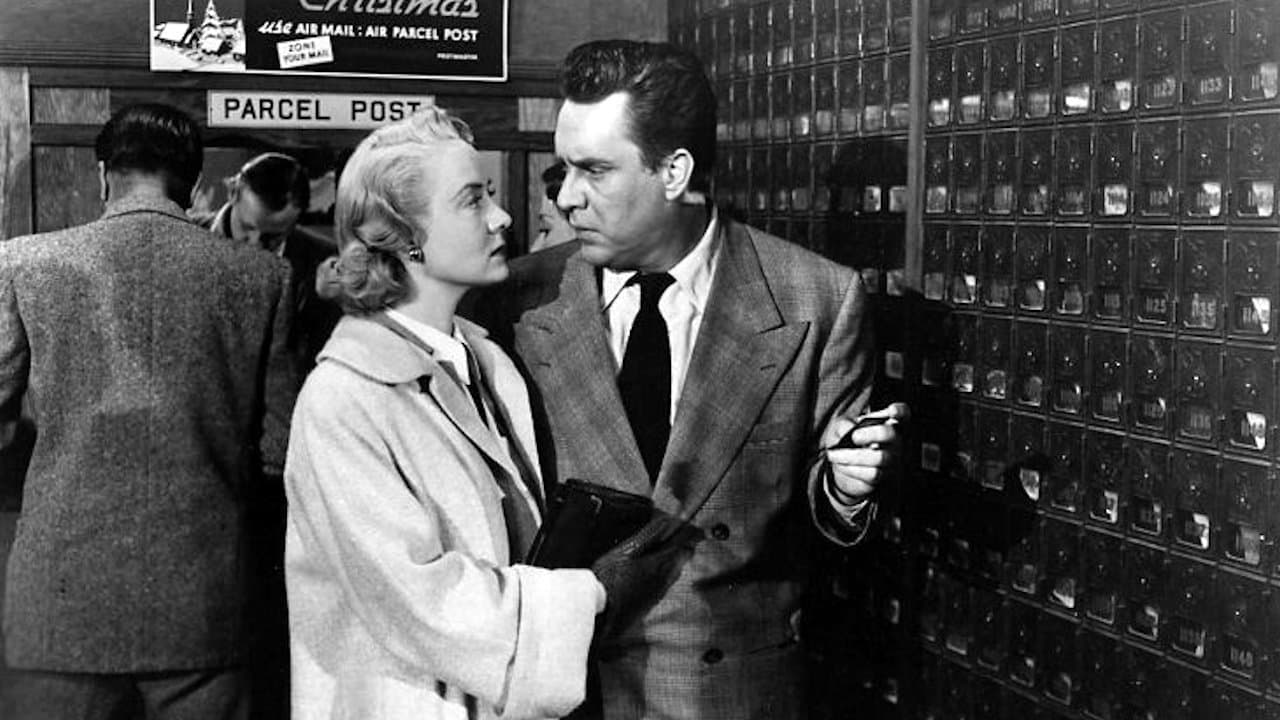
Man in the Dark arrived in 1953 as part of Columbia's aggressive push into 3-D exhibition, yet the film beneath the format is a compact, unrhetorical noir that takes its central conceit seriously. The amnesia premise, a genre staple often deployed for melodramatic convenience, here carries real moral weight: if the surgery has genuinely severed Steve Rawley from his criminal self, the violence that follows is being visited on a man who is, in a meaningful sense, innocent. Lew Landers directs without distinction but without waste, keeping the film moving at a pace that suits its seventy-minute economy. Edmond O'Brien anchors the material with the physical weariness he brought to D.O.A. two years earlier – a man under siege from circumstances he can feel but not name. Audrey Totter, always reliable in morally suspended roles, gives Peg a reserve that the script does not entirely earn. The film's real argument, understated and period-specific, concerns rehabilitation as institutional fiction: the state remakes the criminal, then abandons him to the very forces the state never reached.
– Classic Noir
The sequence unfolds on a working roller coaster at an amusement park, shot with the 3-D cameras angled to exploit every vertiginous drop and lateral lurch of the structure. Floyd Crosby keeps the frame unstable in ways that exceed mere exhibition novelty: low angles beneath the coaster track compress sky into thin strips, while the wooden superstructure forms a lattice of shadow across the figures scrambling through it. Light is functional and harsh – no atmospheric fill, no romantic half-dark – the brightness of a public space that refuses cover.
The choice of location strips the chase of any noir glamour. There is no nocturnal city, no rain-slicked alley. The pursuit happens in the open, under lights designed for entertainment, among the architecture of public leisure – which makes the violence feel more destabilizing, not less. Rawley has no memory to guide him and no terrain that belongs to him. The roller coaster, endlessly cycling through its fixed track, becomes an image of his condition: motion without direction, danger with no exit that he can name.
Floyd Crosby came to Man in the Dark with credentials unusual in the genre – an Oscar for Tabu (1931) and significant documentary experience – and his work here reflects a DP less invested in noir's expressionist inheritance than in functional, pressure-driven composition. Shooting for 3-D imposes its own discipline: depth staging must be deliberate, foreground elements chosen not for decorative shadow play but for spatial aggression. Crosby obliges without overreach. Interior sequences rely on hard key lighting that flattens shadow rather than sculpts it, a choice that suits the film's institutional settings – hospital corridors, back rooms, interrogation spaces – where the genre's characteristic chiaroscuro would feel too romantic. Location work, including the amusement park finale, trades studio control for ambient confusion, the camera reactive rather than composed. The visual language overall serves the film's argument about a man with no interior darkness left to hide in – the world is simply, relentlessly lit, and Rawley is exposed in all of it.
Tubi has carried Man in the Dark in a watchable public-domain-adjacent print; confirm availability before viewing as catalog rotation applies.
Archive.orgFreeA digitized print is available for free streaming and download, making this the most reliably accessible version for researchers and general viewers alike.
Amazon Prime VideoSubscription / RentalAvailability on Prime varies by region; check current listings, as the film surfaces periodically through third-party channel add-ons.