Rick Mason is a small-time grifter operating under the direction of Silky Randall, a cool and calculating syndicate figure who runs a tight crew including the volatile Tory and the steady Duke. Their scheme is precise: identify a wealthy widow, insert Rick as a charming suitor, and fleece her before she knows what has happened. The mark is Deborah Owens Clark, a war widow sitting on a substantial memorial fund intended to honor her late husband with a veterans' recreation center. Rick arrives in her California coastal town polished and purposeful, every gesture calibrated to earn her trust.
The complication is Deborah herself. She is neither naive nor pliable, and Rick's practiced indifference begins to fracture under genuine feeling. Tory, who has her own claim on Rick, watches with mounting jealousy, while Silky grows impatient with the pace of the operation. The crew's internal tensions surface: Max pushes for escalation, Duke tries to hold the center, and Rick is caught between a scheme he can no longer prosecute cleanly and a woman he can no longer deceive without cost. The money remains the object, but loyalty and desire have destabilized the plan.
Larceny belongs to the postwar cycle of confidence films in which criminality is less about violence than corrosion – the slow erosion of character under the pressure of greed and bad company. The film uses the veterans' memorial as a pointed moral frame: the money being stolen is explicitly tied to sacrifice and civic decency, making Rick's hesitation something more than romantic sentiment. What the film builds toward is a reckoning that tests whether a man formed entirely by expedience can locate, at the last moment, anything worth keeping.
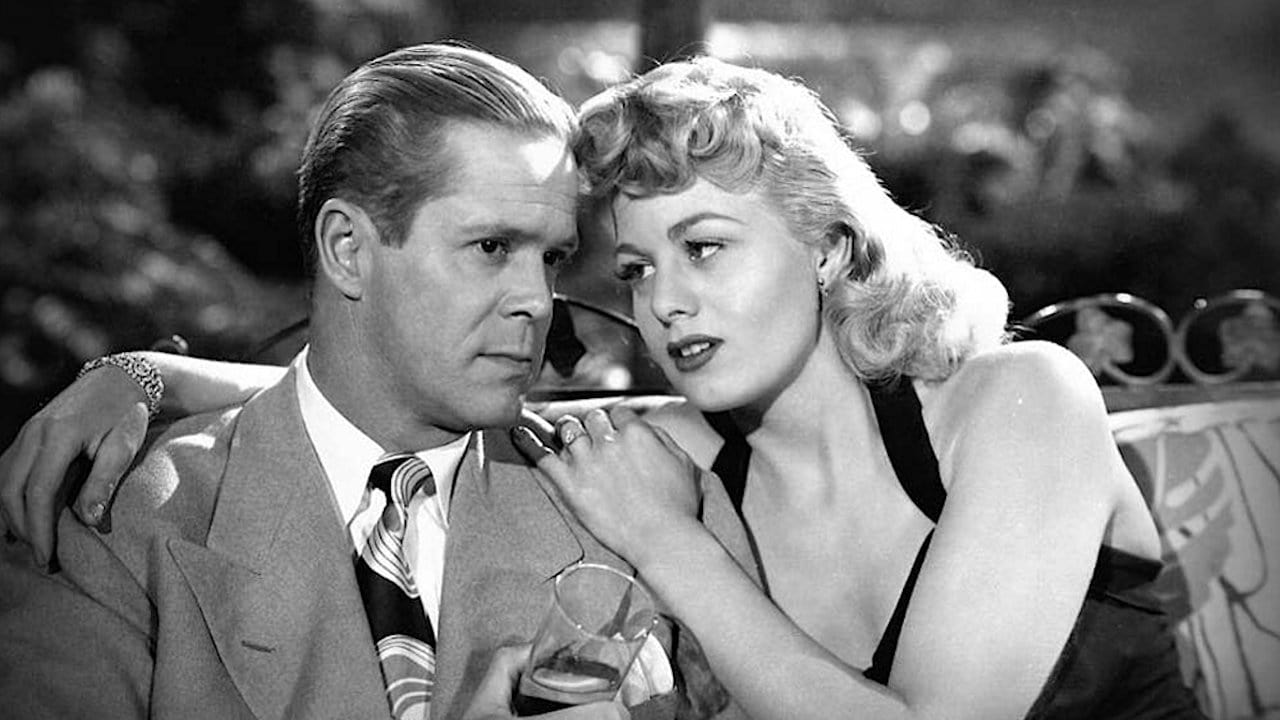
Larceny arrives in 1948 at a moment when Universal International was producing competent mid-tier noir with reliable contract players rather than prestige productions, and George Sherman directs accordingly: economically, without waste, and with a cleaner genre intelligence than his reputation sometimes suggests. John Payne had recently begun his transition from musical leads to harder material, and his Rick Mason benefits from that ambiguity – a face too agreeable for a pure villain, too knowing for an innocent. Dan Duryea, cast again as the silky antagonist the studio knew he could deliver, gives Silky Randall the unhurried menace that distinguishes his best work. Shelley Winters, still in the early phase of her career, brings a bruised volatility to Tory that the script does not fully earn but that she supplies from her own resources. What makes Larceny worth attention beyond its craft is the moral architecture of its central con: the stolen funds are a war memorial, which in 1948 was not a neutral detail. The film frames Rick's corruption against a specific postwar debt, and that framing gives the standard redemption mechanics unexpected weight.
– Classic Noir
The scene plays on an exterior location with the Pacific light flattening the figures against sand and pale sky – Irving Glassberg keeps the frame deliberately open, refusing the shadow architecture that would signal noir danger indoors. Tory approaches Rick in full daylight, and the absence of protective shadow is the point: there is nowhere for either of them to retreat into ambiguity. The camera holds on Winters at medium distance, close enough to read the calculation behind the anger, far enough to place her within the exposed geography of a con that has run out of cover.
What the scene establishes is that Tory understands the game better than Rick currently does. Her jealousy is real, but her leverage is professional – she knows where the scheme stands and what Rick's sentiment is costing the crew. The confrontation positions her not as a scorned woman but as a pragmatist with a grievance, which briefly shifts the film's moral center. Rick's discomfort in the open light is the scene's argument: a man built for controlled environments who has allowed something uncontrolled to enter the operation.
Irving Glassberg's work on Larceny is characteristic of his Universal International period – technically assured, attentive to contrast, and willing to let location work carry what a more studio-bound production would solve with constructed shadow. Glassberg does not impose a uniform expressionist vocabulary on the film; instead, he modulates the lighting register to track Rick's moral position. Interior scenes with Silky's crew favor harder sources and compressed framing, the geometry of the room working as constraint. Scenes with Deborah move toward softer, wider compositions – not romantically lit so much as ethically clarified, the light exposing rather than concealing. The beachside exteriors disrupt both registers, substituting the flatness of California coastal light for the moral encoding of shadow. Glassberg's lens choices remain close to the classical normal range throughout, which keeps Rick legible and prevents stylization from providing him an alibi. The visual logic consistently insists that the con man be seen clearly, which is ultimately what the film is about.
Tubi has carried Universal International titles from this period without subscription cost, making it the most accessible starting point, though print quality varies.
Amazon Prime VideoRentalAvailable for digital rental with a generally cleaner transfer than free streaming sources; confirm current availability before seeking.
Archive.orgFreePublic domain versions of mid-tier Universal titles from this era occasionally appear here; transfers are inconsistent but the access is immediate and free.