On a train pulling into New York on Christmas Eve, Nikki Collins, a wealthy San Francisco socialite with a taste for detective fiction, witnesses a murder through the window of a passing mansion. The victim, she will learn, is Josiah Waring, patriarch of a prominent and fractious family. When Nikki reports what she saw to the police, she is dismissed without ceremony. Determined to see justice done, she takes matters into her own hands, enlisting the reluctant help of Wayne Morgan, a pulp crime novelist whose books she admires and whose apartment she more or less invades.
Nikki's investigation draws her into the Waring household, where she poses as Margo Martin, a nightclub singer, in order to get close to the principal suspects: Arnold Waring, the scheming nephew played with characteristic cold relish by Dan Duryea; the imperious Jonathan Waring; and a retinue of associates with motives to spare. The deeper Nikki reaches into the family's affairs, the more the film complicates her amateur certainty, surrounding her with men who alternately patronize her, pursue her, or fear what she might uncover. Morgan, meanwhile, is pulled between professional skepticism and growing personal investment.
Lady on a Train occupies an unusual position in the 1945 Universal catalogue – a film that grafts screwball comic energy onto a genuine murder plot, then runs both registers simultaneously without fully committing to either. The result is a noir-adjacent entertainment that uses the genre's standard furniture – the duplicitous household, the woman who knows too much, the corrupt or indifferent establishment – while keeping its protagonist buoyant enough to survive them all. The tonal tension is the film's defining quality, and whether that reads as charm or evasion depends entirely on what the viewer asks of it.
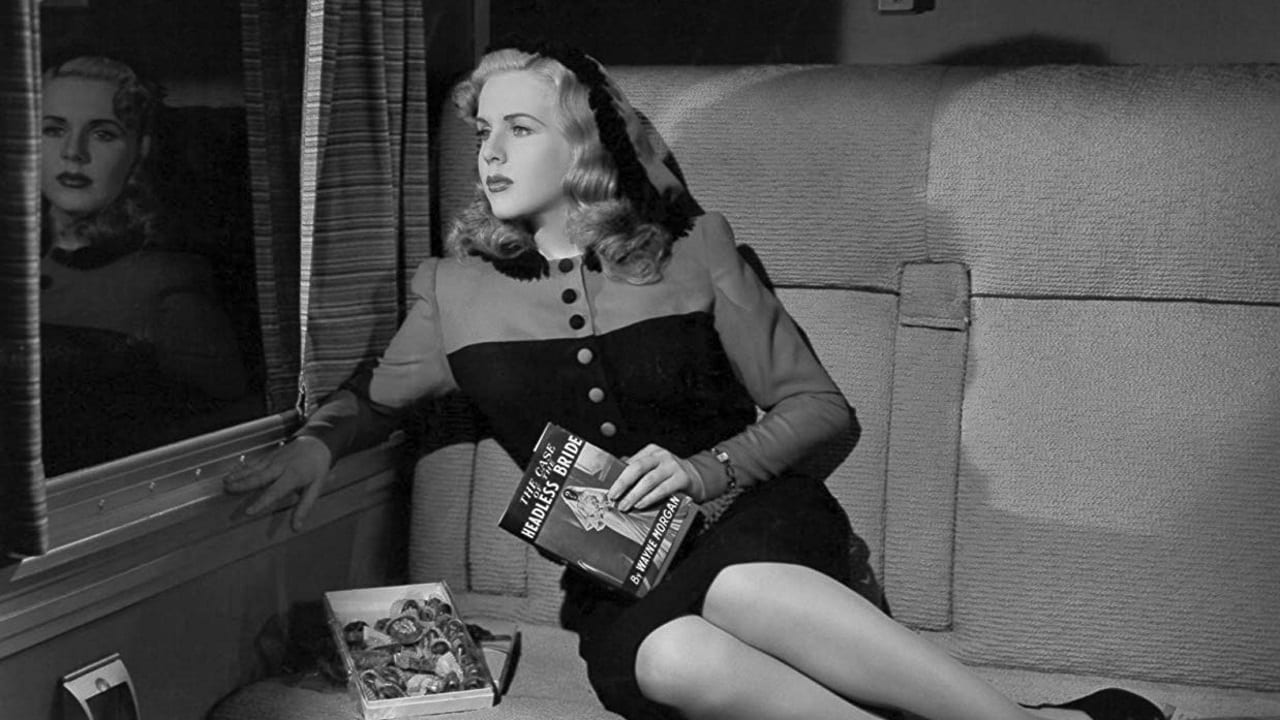
Lady on a Train is a film that declines to be straightforwardly categorized, which is part of what makes it worth examining. Deanna Durbin was Universal's reliable box-office insurance, and the studio's decision to place her inside a murder mystery – complete with a Miklós Rózsa score that pulls toward genuine menace – reveals something about how fluid genre boundaries were in mid-decade Hollywood. Charles David directs without particular visual ambition, but he manages the tonal shifts competently, and the casting of Dan Duryea as Arnold Waring gives the film its sharpest edge: Duryea's particular brand of thin-lipped malevolence provides a credible threat that the script occasionally earns. Ralph Bellamy's Jonathan Waring and Edward Everett Horton's Haskell function primarily as comic counterweights. The film does not sustain its noir atmosphere across its full 94 minutes, but it uses that atmosphere strategically, deploying shadow and moral uncertainty in the sequences that need them most. As a document of wartime Hollywood's appetite for crime entertainment softened by star persona, it is genuinely instructive.
– Classic Noir
The scene unfolds in the Waring parlor, where Nikki – performing the identity of Margo Martin – finds herself at the center of the assembled family. Elwood Bredell holds the camera at a middle distance, wide enough to map the power geometry of the room: Duryea's Arnold at the frame's edge, slightly out of the primary light source, his face half-caught in the shadow that pools beside the heavy drapes. Nikki occupies the center, lit from above in a manner that flatters Durbin while subtly isolating her from the surrounding figures. The composition works against her comfort even as her performance projects confidence.
What the scene argues is that Nikki's amateur courage, however genuine, does not protect her from the room's actual stakes. Arnold watches her with the patient attention of someone who already suspects the performance, and Bredell's framing – keeping him peripheral but never absent – ensures the viewer shares that unease. The sequence encapsulates the film's central tension: a protagonist whose genre is comedy placed inside a house that belongs to something considerably darker.
Elwood Bredell, who had already shot The Phantom Lady for Universal in 1944, brings to Lady on a Train a more modulated approach than that film's expressionist extremes demanded. Working predominantly on studio-built sets, Bredell constructs interiors that use deep shadow not as stylistic statement but as environmental pressure – light that falls on Nikki tends to be cleaner, more direct, while the Waring family members are repeatedly caught in half-light or positioned near windows whose outside darkness registers as a kind of moral weather. The train sequence that opens the film deploys a tight focal length against a rear-projected exterior, and Bredell uses the passing light sources to create a rhythm of illumination and occlusion that sets up the murder with more economy than elaborate staging would have allowed. The cinematography does not attempt to overwhelm the film's comedic surface, but it runs beneath it as a persistent undertow, ensuring that when the screenplay requires genuine menace, the visual grammar is already in place to support it.
Universal's classic catalogue titles appear regularly on Peacock, making this the most likely streaming home for Lady on a Train in a stable, accessible transfer.
TCMBroadcast / Subscription (Max)TCM periodically programs Durbin and mid-decade Universal titles; availability through the Max bundle varies by scheduling cycle.
Archive.orgFreeThe public domain status of some prints of this title means versions surface on Archive.org, though transfer quality varies and should be verified before use as a reference print.