Irish merchant seaman Michael O'Hara encounters Elsa Bannister in Central Park one evening, rescues her from an assault, and is drawn into the orbit of her husband – Arthur Bannister, a celebrated and physically disabled criminal defense attorney of formidable reputation. Bannister hires O'Hara to crew his yacht for a voyage from New York through the Panama Canal to San Francisco, and O'Hara, already captivated by Elsa, accepts against his better instincts.
During the voyage, Bannister's oily business partner George Grisby makes O'Hara a strange proposition: sign a confession to Grisby's murder, collect five thousand dollars, and face no legal consequences since without a body there can be no conviction. O'Hara, intending to use the money to run away with Elsa, agrees – only to find himself implicated in an actual killing when Grisby turns up dead and the scheme collapses into a tangle of competing designs that O'Hara is too late to read clearly.
The film is one of Hollywood noir's most formally audacious works, using its waterborne setting and a labyrinthine plot to examine how desire distorts perception and how the law can be weaponized by those who know its machinery. Its celebrated trial sequence and funhouse-mirror finale locate it at the baroque edge of the genre, where style and moral argument become inseparable.
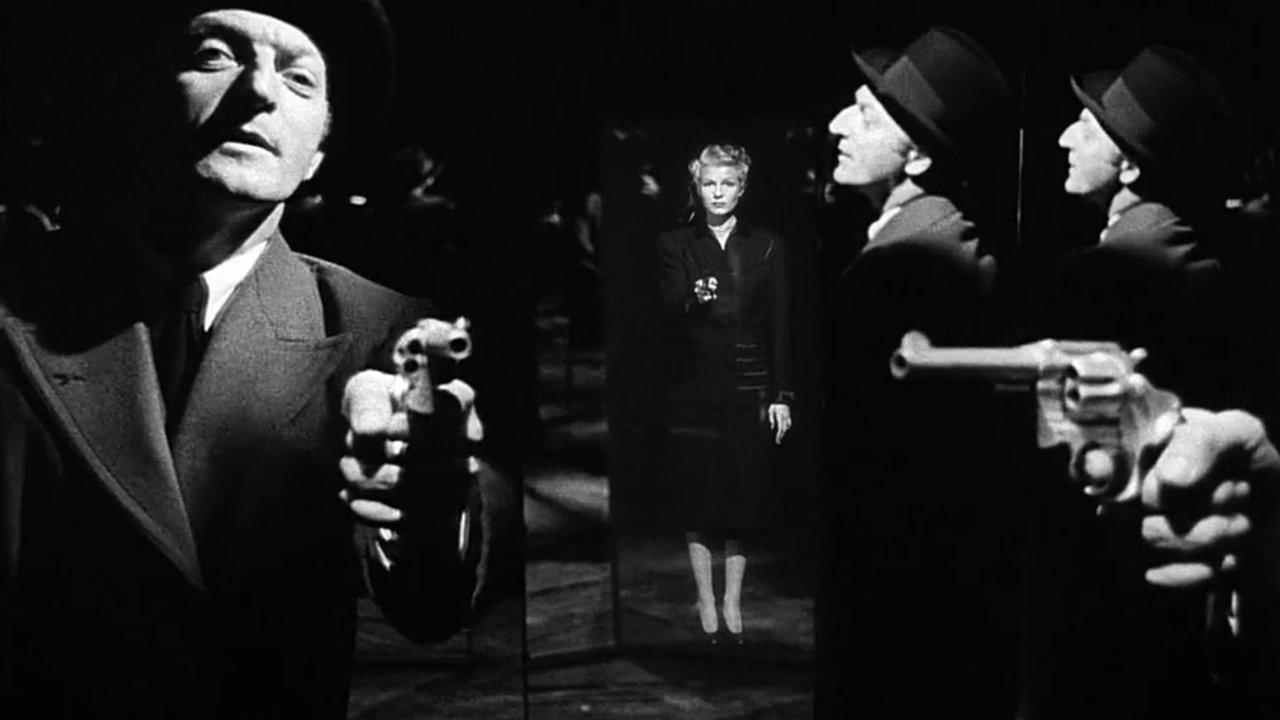
Welles made Lady from Shanghai under considerable studio pressure – Columbia's Harry Cohn reportedly hated the film and buried it for two years before release – and the tension between its director's instincts and institutional resistance is legible in the final cut. What survives is a noir that treats the genre's conventions as instruments for epistemological inquiry: O'Hara cannot read Elsa correctly, cannot parse the legal performance Bannister stages, cannot follow Grisby's logic to its conclusion. The film argues that romantic projection is itself a form of moral blindness. Rita Hayworth, shorn of her famous red hair for the role, is deployed against her star image with deliberate coldness; Everett Sloane's Bannister is among the genre's most unsettling antagonists, a man whose disability functions as both misdirection and emblem of corrupted power. Charles Lawton Jr.'s cinematography works in service of disorientation rather than atmosphere for its own sake. The film does not resolve into reassurance. It ends on exhaustion, not triumph.
– Classic Noir
The camera moves through a carnival funhouse in which floor-to-ceiling angled mirrors multiply every figure into a dozen distorted versions of itself. Lawton's lens – working in a space designed to defeat coherent geometry – finds no stable frame; every composition fractures before it can settle. Light bounces between surfaces so that shadow and illumination lose their conventional moral assignments. Welles shoots the confrontation between O'Hara, Elsa, and Bannister as a sequence of reflections firing at reflections, the real figures briefly indistinguishable from their copies.
The scene crystallizes the film's central argument: that O'Hara has never seen Elsa as she is, only as refracted through his own longing. When the mirrors shatter, the proliferating images collapse, but what remains is not clarity – it is wreckage. The sequence renders visually what the entire film has been constructing narratively: that in this world, the multiplied image is the only available reality, and the person who mistakes a reflection for a person will be destroyed by the confusion.
Charles Lawton Jr. operates throughout Lady from Shanghai in a mode of controlled instability. Working on location aboard a yacht and through the waterways of Acapulco, as well as on Columbia studio sets, he uses the ship's physical confines to force compositions that crowd the frame and deny characters spatial comfort. On open water, his wide shots flatten figures against glittering, undifferentiated light – a visual condition that refuses the shadowed urban expressionism of conventional noir and substitutes something more disorienting: too much visibility, nothing clarified. In interiors, particularly the trial sequence and the funhouse climax, Lawton shifts to dense shadow work and extreme angles that destabilize hierarchy within the frame. He does not consistently favor long lenses or short; the instability is the point. His lighting setups deny the audience a reliable moral grammar – the virtuous and the corrupt inhabit the same tonal register. That refusal to resolve light into ethical clarity is the cinematography's most coherent contribution to the film's argument.
The Criterion Channel presents a clean transfer that preserves Lawton's tonal range and is the most reliable streaming source for the film.
TubiFreeTubi has carried the film in the past as a free, ad-supported stream, though print quality and availability should be verified before viewing.
Archive.orgFreeA public domain version is available on Archive.org; transfer quality varies and this option is best treated as a last resort.