Films People Pull a Fast One Night Beat Reading Room On TV Shop
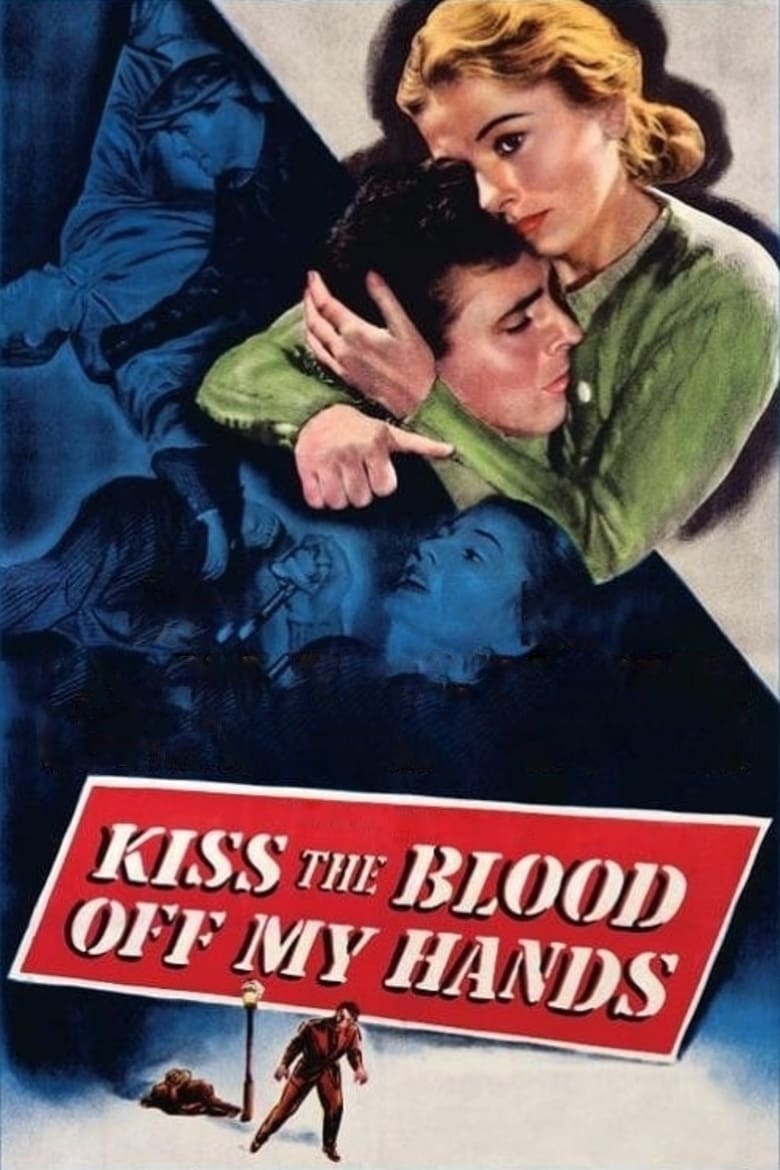
Kiss the Blood Off My Hands 1948
1948 Norma Productions
★★★☆☆ Notable
Film Noir · 79 minutes · Black & White

Kiss the Blood Off My Hands

Directed by Norman Foster
Year 1948
Runtime 79 min
Studio Norma Productions
TMDB 6.5 / 10
"A man running from himself finds the one person who makes stopping worth the risk."

London, 1948. Bill Saunders, a Canadian veteran still unmoored by the war, kills a pub landlord during a drunken altercation and flees into the night. He takes refuge in the room of Jane Wharton, a quiet relief-agency worker who, rather than turn him in, allows him to hide. The city outside is grey and close, a postwar capital still sorting through its rubble, and both characters carry damage that precedes this particular night.

Jane's decision to shelter Bill draws them into a fragile, complicated bond, but the film refuses to let sentiment settle. Harry Carter, a small-time criminal who witnessed the killing, locates Bill and begins extorting him – first for money, then for complicity in a smuggling operation. Bill, already a man without legal standing, finds his options narrowing at every turn. Jane, who has staked something real on his capacity for change, is pulled closer to a situation she cannot fully control.

Kiss the Blood Off My Hands places its noir mechanics in postwar British working-class London rather than the American urban landscape that defined the cycle, using that displacement to examine guilt and reformation as social as well as psychological problems. Whether the system will permit a damaged man any path back is the film's central, unresolved tension, and Norman Foster keeps that question open until the final minutes.

Classic Noir

Produced by Burt Lancaster's own Norma Productions and adapted from Gerald Butler's novel, Kiss the Blood Off My Hands is a transatlantic production that sits at an interesting angle to the American noir mainstream. Shot almost entirely on studio sets dressed to evoke postwar London, it uses its foreign setting not for exoticism but for displacement – the city becomes a moral environment stripped of the familiar American grammar of crime and consequence. Lancaster, still early in his career, plays Saunders with a physical intensity that registers trauma rather than menace, and Fontaine gives Jane a steadiness that avoids the standard fatale or victim poles. Robert Newton's Carter is the film's most purely noir figure: calculating, almost cheerful in his corruption. What the film ultimately argues – and what locates it in its historical moment – is that postwar society's capacity to absorb and redeem its damaged men is genuinely uncertain. That uncertainty, rather than any formal stylistic achievement, is where the film earns its place in the genre.

– Classic Noir
3 ★★★☆☆ Notable
Credits

The Crew

DirectorNorman Foster
ScreenplayLeonardo Bercovici
CinematographyRussell Metty
MusicMiklós Rózsa
EditingMilton Carruth
Art DirectionNathan Juran
ProducerRichard Vernon
Performances

The Cast

Close Reading

The Signature Scene

Kiss the Blood Off My Hands – scene
The Waterfront Confrontation Carter Holds All the Cards

Russell Metty frames the scene in a compressed dock interior where horizontal lines of timber and rope reduce the available space until Lancaster and Newton seem to occupy a corridor rather than a room. The key light falls from a high lateral angle, cutting Newton's face into wedges of shadow and illumination while Lancaster is kept in a flatter, more exposed light – visually pinned, already caught. Metty holds the two-shot long enough for the power geometry to register before cutting to tight singles that emphasize not eyes but mouths and hands.

The scene crystallises the film's central argument about complicity. Bill Saunders has survived the war only to discover that peacetime has its own coercions, and that a single act of violence has handed leverage to someone who trades in exactly this kind of debt. Carter does not threaten so much as explain, reasonably, how things now stand. That reasonableness is the scene's chill: the machinery of entrapment here is entirely human and entirely mundane.

Visual Language

The Cinematography

🎞️
Russell Metty – Director of Photography

Russell Metty, who would later shoot Touch of Evil for Orson Welles, brings to Kiss the Blood Off My Hands a disciplined approach to studio-constructed location work. The London of the film is built from shadow and selective detail rather than breadth – narrow streets suggested by a wall and a lamp, interiors defined by what the light refuses to show. Metty works with a consistently high contrast ratio, using hard sources to create deep lateral shadows that compress the frame and reinforce the story's logic of entrapment. There is little use of wide establishing coverage; the camera tends to move in close and stay there, keeping characters within tight spatial boundaries that mirror their circumstances. His lens choices favor a slightly longer focal length in interiors, flattening depth and pressing figures toward the frame's edges. The result is a visual grammar in which the environment itself behaves as an antagonist – not through expressionist distortion but through the simpler and perhaps more honest mechanism of refusing characters room to breathe.

In the Catalogue

Themes & Motifs

Availability

Where to Watch

Also in the Directory

See Also