Johnny O'Clock (Dick Powell) is a polished, self-possessed partner in a high-end gambling club run by Pete Marchettis (Thomas Gomez), a man Johnny knows to be dangerous and whose wife Nelle (Ellen Drew) Johnny once loved. When a hat-check girl named Harriet Hobson (Nina Foch) turns up dead – the same girl who had been wearing a watch given to Johnny by a corrupt cop now also deceased – Inspector Koch (Lee J. Cobb) begins circling Johnny with the patient deliberateness of a man who already knows the answer and is waiting for the evidence to catch up.
Harriet's sister Nancy (Evelyn Keyes) arrives in the city looking for answers and finds herself drawn into a relationship with Johnny that neither of them can entirely explain or safely afford. Johnny, who has survived by keeping his loyalties provisional and his emotions controlled, is pulled in competing directions: Pete grows suspicious, Nelle's feelings for Johnny remain unresolved and volatile, and Koch tightens his net with each interview. A figure named Charlie (John Kellogg) and club enforcer Chuck Blayden (Jim Bannon) complicate the internal politics of the operation, and the line between Johnny's careful self-interest and genuine culpability grows harder to locate.
Robert Rossen's debut as a director places Johnny O'Clock in the company of late-1940s noirs organized around male protagonists who are neither innocent nor fully corrupt – men suspended between the criminal world that made them and a legitimacy they can no longer quite reach. The film uses that suspension as its structural principle, building toward a reckoning that is less about crime solved than about the cost of accommodation.
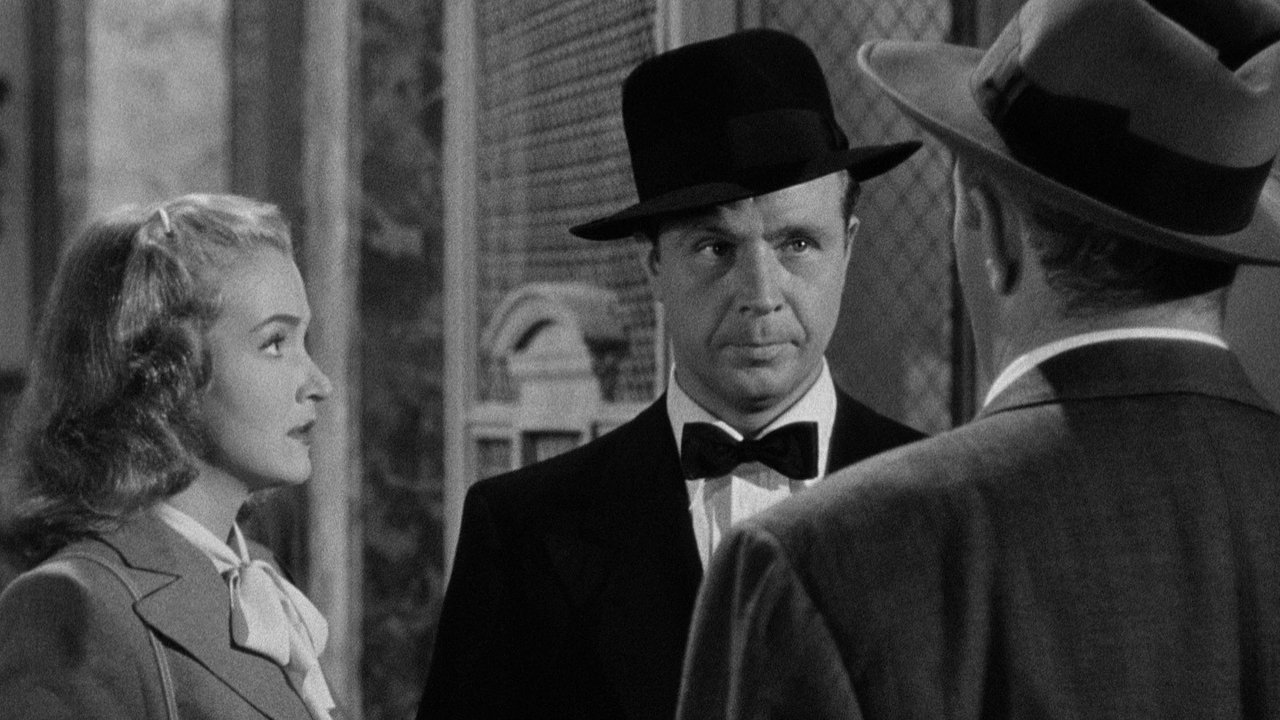
Johnny O'Clock arrived in 1947, the year Robert Rossen was consolidating a reputation as one of Hollywood's more politically alert writers, and his directorial debut carries the marks of a screenwriter's intelligence: the dialogue is load-bearing, the character reveals come through conversation rather than action, and the moral architecture is more rigorous than the genre usually demands. Dick Powell, still in the process of dismantling his earlier musical-comedy persona, finds in Johnny a figure who uses surface composure as both armor and trap – a man whose principal skill is reading rooms and who meets his undoing when a room he thought he understood turns out to contain something genuine. Lee J. Cobb's Koch is not the corrupt or incompetent cop of much noir convention but an intelligent institutional force, which raises the stakes. Burnett Guffey's photography keeps the gambling-club interiors plausible and claustrophobic without pushing into expressionist excess. The film does not fully resolve every thread it opens, and its pacing occasionally slackens in the middle section, but as an account of how cultivated detachment fails its practitioner, it earns its place in the cycle.
– Classic Noir
Guffey places Koch and Johnny on opposite sides of a desk that functions less as furniture than as a contested border. The key light falls on Koch at a slight downward angle, giving Cobb's broad face an institutional solidity, while Johnny is lit more evenly – composed, readable, almost too readable. The camera maintains a conversational distance rather than closing in for psychological pressure, which makes the scene's menace quieter and in some ways more effective: Koch does not need theatrical proximity to make his weight felt. Cut-ins to Johnny's hands, still on the desktop, register the effort of control.
The scene is the film's clearest statement of its central argument. Johnny has constructed his life around the principle that information is leverage and that a man who gives nothing away cannot be touched. Koch, who has his own kind of patience, demonstrates that this philosophy has a structural flaw: it requires the world to cooperate, and the world has stopped cooperating. What the scene reveals is not guilt in any simple legal sense but the exhaustion of a particular mode of self-protection – the moment when the performance of invulnerability begins to cost more than the alternative.
Burnett Guffey, who would go on to shoot Bonnie and Clyde two decades later, was already working with a precise understanding of how light defines social space, and his contribution to Johnny O'Clock is underappreciated relative to the film's reputation. Shooting largely on studio sets for J.E.M. Productions, Guffey avoids the temptation to signal noir through shadow alone; instead he calibrates the lighting to character function, giving the gambling club a surface brightness that reads as performative and therefore suspect, while the back rooms and private conversations are handled with tighter contrast and deeper fill shadow. There are no baroque camera angles working against the drama. Guffey keeps the frame stable and the compositions classical, which places the moral instability entirely in the performances and dialogue rather than diffusing it into visual style. The result is a film that looks controlled because its protagonist is controlled, and begins to fragment compositionally only when that control begins to fail – a structural use of cinematography that serves Rossen's thematic concerns without announcing itself.
The most reliable streaming home for Columbia-era noir of this period; check current availability as titles rotate.
TCMBroadcast / SubscriptionTCM has aired Johnny O'Clock periodically as part of its noir programming blocks; available on-demand through Max for TCM subscribers.
Archive.orgFreeA public-domain or out-of-license version may be available, though transfer quality is variable and should be confirmed before use.