Bart Madden (Preston Foster) is a former convict trying to go straight in a small American city, where he takes up with Claire Norton (Ann Rutherford) and her younger brother Eddie (Alan Curtis). Madden's past makes him a convenient suspect whenever trouble surfaces, and trouble surfaces quickly – the kind that involves money, connections, and men who do not want their names spoken aloud.
When a crime implicates someone close to Madden, the district attorney (Milburn Stone) and a police captain (Joe Sawyer) tighten the institutional pressure, while a local hood named Donovan (Marc Lawrence) works the margins for his own ends. Eddie's entanglement deepens the bind: Madden must decide whether loyalty to the Nortons accelerates his own destruction or offers his only path to legitimacy. The line between protecting someone and covering for them blurs with each new complication.
Inside Job belongs to the cycle of postwar B-noirs built around the rehabilitated criminal whose past refuses to stay buried. The film works the procedural and the personal simultaneously, positioning its modest 65-minute frame as a study in institutional distrust and the limited room that society allows a man marked by the system.
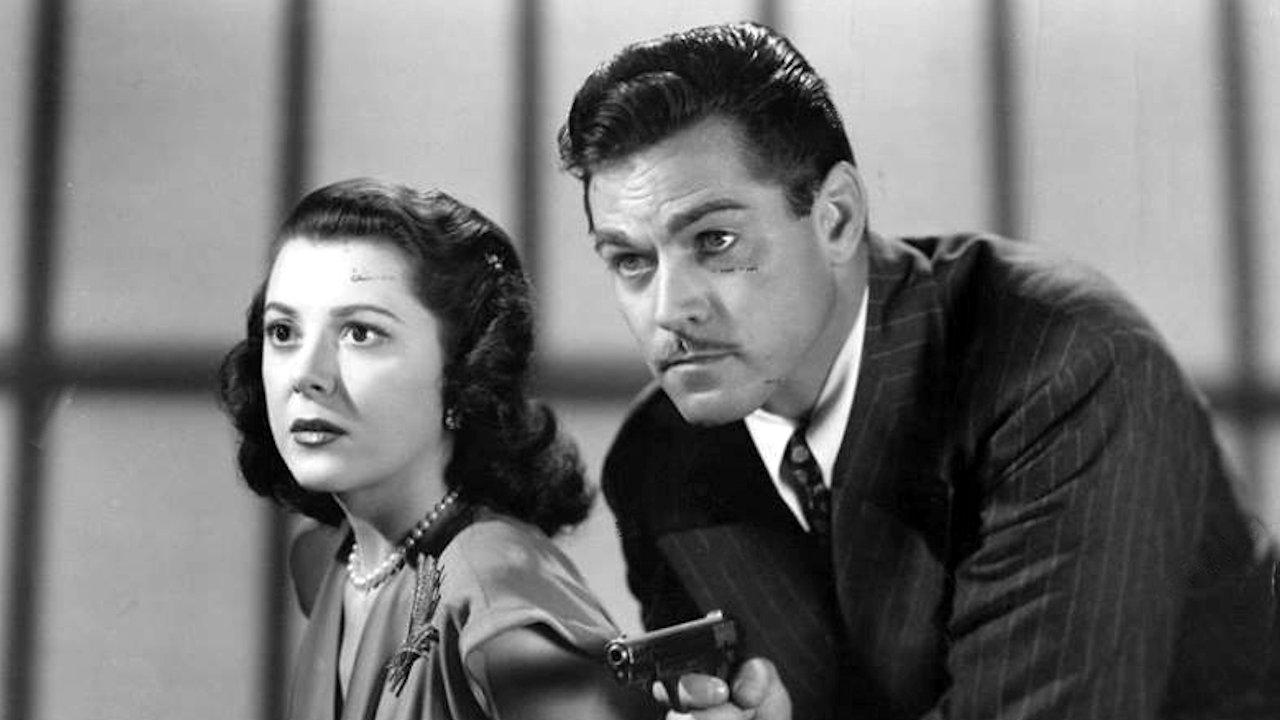
Inside Job is a minor but functionally efficient entry in Universal's mid-forties crime program, directed by Jean Yarbrough with the workmanlike discipline that the studio's B-unit demanded and occasionally rewarded. Preston Foster carries the film on the credibility of his physical stillness – Madden is a man who has learned to take up less space, and Foster communicates that without underlining it. Marc Lawrence, reliable in these supporting villain slots, brings his usual coiled menace to Donovan, and Milburn Stone's district attorney is the kind of institutional antagonist noir used to examine the machinery of legal pressure rather than just criminal threat. The film is not interested in rehabilitation as sentiment; it is interested in rehabilitation as tactical problem, which gives it a harder edge than its B-status might suggest. What it reveals about its era is the postwar ambivalence about reintegration – the gap between the rhetoric of second chances and the practical architecture of surveillance and suspicion that made those chances largely theoretical.
– Classic Noir
The camera holds Madden at medium range against a wall cross-hatched by the shadow of venetian blinds, the striped light falling across his chest and lower face so that his eyes remain just clear of the pattern. The district attorney occupies the brighter foreground, his back partially to the lens, using the compositional weight of institutional authority. The frame keeps Madden hemmed in without cutting to a close-up, letting the geometry of the room do what dialogue cannot.
The scene argues that Madden's past is a structural condition, not a personal flaw – the blinds' bars are not symbolic ornament but a visual statement of fact. He is already inside a kind of sentence. What the moment reveals is that the film's real subject is not guilt or innocence but the way a record functions as permanent evidence, overriding whatever a man has actually done in the intervening years.
The cinematographer on Inside Job is not confirmed in available production records, which is not unusual for Universal's B-unit pictures of this period, where crew assignments were often rotational and uncredited in surviving documentation. What the film's visual texture suggests is a competent house-style application of low-key studio noir: tight interior sets lit with hard sources to produce strong directional shadows, minimal fill, and the kind of confined framing that turns low budgets into expressive pressure. The camera rarely moves independently of story logic – dolly work is reserved for moments of revelation or entrapment rather than atmosphere for its own sake. Location footage, where it appears, is kept brief and functional. The moral logic of the lighting is consistent: institutional spaces are harder and more evenly lit, private spaces more choked with shadow, mapping the difference between the world that surveils and the world that conceals.
Tubi has carried a number of Universal B-noirs from this period in watchable transfers; availability shifts but this is the most likely free option.
Archive.orgFreePublic domain prints of mid-forties Universal program pictures frequently appear here, though transfer quality varies significantly.
Amazon Prime VideoSubscriptionClassic Universal titles from this era occasionally surface through Prime's rotating catalog or affiliated channels; verify current availability before seeking.