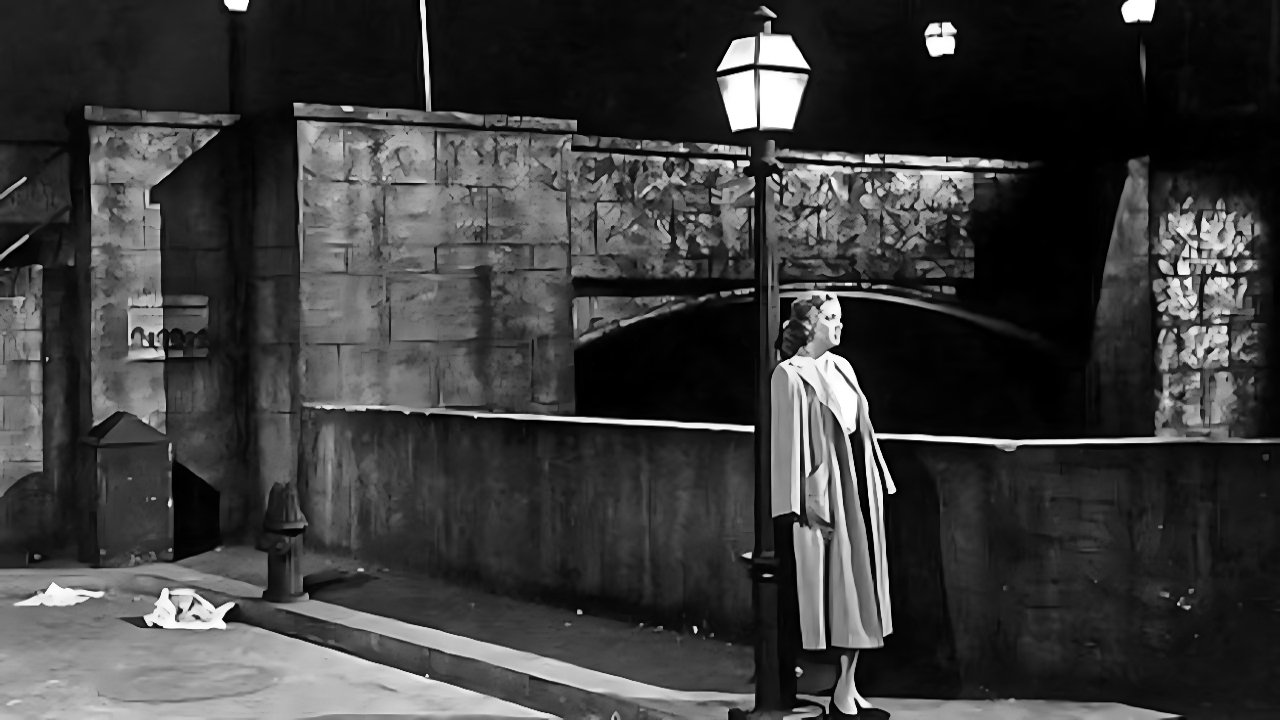
David Toman, an aging, partially deaf watchmaker living quietly in a California coastal town, pulls a young woman named Clara Barker from the edge of a bridge one night. Clara is broke, beautiful, and evasive about her reasons for standing there, and Toman, lonely in the way that only solitary men of a certain age can be, takes her in. He finds her work, provides stability, and begins to believe that rescue can become something permanent.
Clara's gratitude curdles slowly into ambition. She attracts the attention of Mario Venti, a younger, more physically imposing man who circulates through the same small world, and the triangle that forms between the three of them carries the familiar geometry of noir: the older man who has invested everything, the woman whose loyalties are uncertain, and the rival who represents everything the older man cannot offer. Toman's deafness, introduced as incidental detail, becomes a structuring irony as conversations and intentions move past him unheard.
Girl on the Bridge belongs to the cycle of low-budget, independently produced noirs that populated American screens in the early 1950s, films made quickly and cheaply but often with a directness that studio productions avoided. Hugo Haas, working from his own production company and frequently casting himself opposite younger women, was developing a recognizable formula across this period – one that interrogates male vulnerability and self-deception with more candor than comfort.
Hugo Haas occupies an unusual corner of American noir: a Czech émigré actor-director who financed his own low-budget productions and repeatedly placed himself at the center of stories about men destroyed by women younger and harder than they are. Girl on the Bridge is an early instance of this formula, and while it lacks the grim confidence of his later Pickup (1951) or Strange Fascination (1952), it establishes the template clearly. What distinguishes Haas's approach is the absence of self-pity; his protagonists are complicit in their own ruin, and the films don't ask the audience to excuse them. Beverly Michaels, in one of her first significant roles, brings a calculating stillness to Clara that resists the femme fatale clichés the part could easily have collapsed into. The film's brevity – 76 minutes – is an asset: Haas understood that his budgets required economy, and he rarely wastes footage on mood that the story hasn't earned. As a document of postwar male anxiety refracted through the lens of immigrant ambition, it rewards attention.
– Classic Noir
Paul Ivano places the camera low and close inside Toman's workshop, the frame crowded with the tools of fine mechanical work – loupes, tweezers, the exposed movements of watches arranged across a velvet pad. The key light falls from a single practical source, a lamp angled to illuminate the work surface, throwing Toman's hands into clarity while his face recedes into partial shadow. When Clara enters the frame behind him, Ivano does not cut; he holds the two-shot, letting her figure stand in the softer, ambient light of the doorway, so that the compositional logic places her precisely where Toman cannot fully see.
The scene concentrates the film's central argument in spatial terms. Toman's world is governed by precision and small, knowable things – mechanisms that behave according to laws he has spent a lifetime learning. Clara exists in the part of the frame where that precision does not reach. His deafness, literalized earlier, is here restated visually: she is present, legible to the audience, and partially obscured from the man who believes he has saved her.
Paul Ivano, a cinematographer whose career stretched back to the silent era and whose work included collaborations with Josef von Sternberg, brings a restraint to Girl on the Bridge that suits both the budget and the material. Working largely on constructed interiors and available California locations, Ivano avoids the expressionist extremes that mark higher-budget noirs of the period, favoring instead a close, slightly oppressive framings that keeps characters in proximity even when their allegiances are diverging. Shadow work is deployed selectively rather than atmospherically – darkness earns its place when it serves a specific dramatic function rather than as ambient texture. The coastal exteriors, shot with available light where possible, give the film a documentary flatness that contrasts with the calculated human behavior occurring within it. Ivano's lens choices favor a moderate focal length that neither flattens space nor dramatizes depth, keeping the moral geometry of the story visible without editorializing.
As a public domain title, Girl on the Bridge is available for free streaming and download here, though print quality varies across uploaded copies.
TubiFreeTubi has carried Hugo Haas titles from this period; availability shifts, but this is among the more reliable free streaming options for the film.
Amazon Prime VideoSubscriptionThe film has appeared via Prime Video add-on channels specializing in classic cinema; confirm current availability before seeking it here.