Leslie Calvin arrives at her relatives' Louisiana bayou plantation still shattered by the torpedo attack that killed her parents and left her adrift, literally and psychologically, in open water. Taken in by Aunt Emily and Uncle Norbert, she is meant to rest, to recover, to remember who she was before the war stripped it from her. The house is quiet and the swamp is close, and the kindly Dr. George Grover, who treats her nerves with a measured professional concern, becomes one of the few fixed points in her unsteady world.
But the plantation's rhythms turn strange. A man named Sydney insinuates himself into the household with an ease that unsettles Leslie even as the others accept him without question. Visions and sounds that may be hallucinations and may not press against her fragile hold on reality. The servants Pearson Jackson and Florella read the situation with a clarity the white characters seem unwilling to risk, and their wariness stands as one of the film's more honest signals. Cleeve, a jumpy figure on the margins, suggests that danger is not imagined but organized.
Dark Waters places its heroine in the gothic American South and uses the bayou's density and humidity as a physical correlative for psychological pressure. The film belongs to the cycle of 1940s gaslight thrillers in which women's sanity is weaponized against them, but de Toth keeps the menace grounded enough to resist pure melodrama, and Rózsa's score refuses to let the audience settle into comfort.
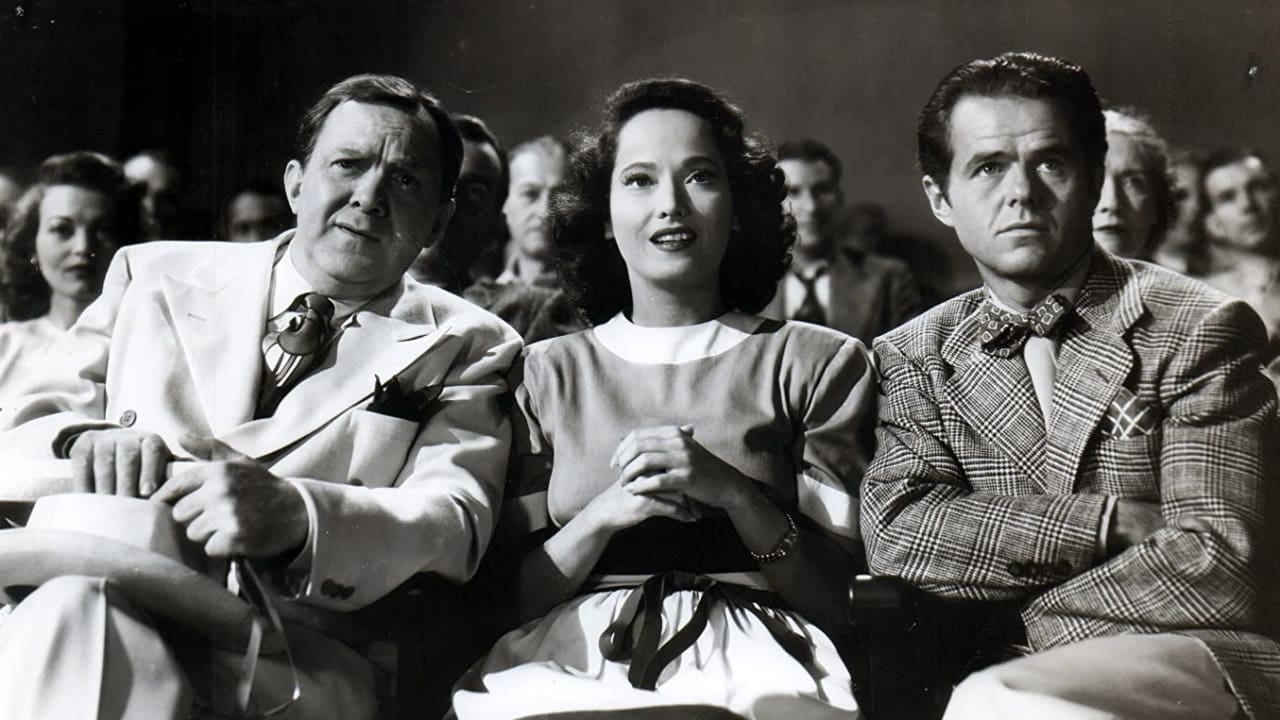
Dark Waters occupies an instructive position within the gaslight noir cycle that flourished briefly in Hollywood between roughly 1944 and 1948. André de Toth, working for the independent Benedict Bogeaus unit, operates without the institutional resources of a major studio but uses the Louisiana locations and Archie Stout's photography to generate atmosphere that many larger productions could not buy. The film's central mechanism – a traumatized woman whose perception of real threat is dismissed as nervous instability – reflects the era's anxious relationship to returned soldiers and civilian trauma alike, displacing those anxieties onto a female protagonist in ways the period found more commercially legible. Thomas Mitchell's Sydney is quietly among the more effective villains in this subgenre precisely because he does very little. Merle Oberon carries substantial weight in a role that demands she appear both lucid and unreliable simultaneously. The film does not resolve all of what it raises, and its treatment of Rex Ingram and Nina Mae McKinney as moral barometers rather than agents is characteristic of Hollywood's limits in 1944, a limitation that now reads as evidence as much as flaw.
– Classic Noir
De Toth and Stout push Leslie into the swamp at night with minimal light sourcing, so the frame becomes a problem of depth: Spanish moss hangs as a scrim in the foreground, the water catches whatever ambient glow reaches it, and Leslie moves through successive planes of darkness rather than through a legible space. The camera holds at a distance that refuses to protect her, neither closing in for subjective terror nor pulling back to ironic detachment.
The sequence crystallizes the film's central argument about knowledge and its withholding. Leslie does not know what pursues her because she has not been permitted to know, and the bayou renders that epistemological condition as landscape. What the frame refuses to illuminate corresponds precisely to what the conspirators have refused to tell her. The swamp is not metaphor so much as structure.
Archie Stout's work on Dark Waters deserves more sustained attention than it typically receives in accounts of 1940s noir photography. Shooting on actual Louisiana locations rather than studio backlots, Stout faces the practical problem that natural swamp settings resist the controlled shadow architectures that studio noir depends on, and his solution is to work with available density rather than against it: the moss, the water, the layered vegetation become natural gobos, so darkness arrives organically rather than as a lighting effect imposed from outside. Interior scenes at the plantation house are handled with harder contrast, using practical source logic – oil lamps, window light from the bayou exterior – to justify the moral opacity of rooms that appear domestic and safe. Stout would later do significant work in 3-D production, and his compositional instinct for foreground-to-background staging is already evident here, lending even quiet two-person scenes a spatial unease that serves de Toth's persistent suggestion that no room in this house is entirely what it presents itself as being.
TCM remains the most reliable television home for this title and airs it periodically in clean prints; Max subscribers with the TCM add-on can check current availability.
Archive.orgFreeDark Waters has circulated in the public domain and Archive.org hosts transfers of variable quality – adequate for research, less so for considered viewing.
TubiFreeTubi has carried public domain prints of this title, though availability shifts; worth checking as a no-cost option when a broadcast source is not accessible.