Films People Pull a Fast One Night Beat Reading Room On TV Shop
Bullet for Joey 1955
1955 Bischoff-Diamond Corporation
★★★☆☆ Notable
Film Noir · 85 minutes · Black & White

Bullet for Joey

Directed by Lewis Allen
Year 1955
Runtime 85 min
Studio Bischoff-Diamond Corporation
TMDB 5.8 / 10
"Two men who built careers on the wrong side of the law find themselves on a collision course neither can afford to survive."

In postwar Montreal, Canadian police inspector Raoul Leduc investigates the disappearance of a nuclear physicist, Dr. Carl Macklin, whose expertise makes him a target of Cold War interest. The trail leads Leduc toward the city's criminal underworld, where exiled American gangster Joe Victor operates a nightclub and a network of dubious connections with practiced ease. Victor, deported from the United States and without a country willing to claim him, is a man running out of room.

Foreign agent Eric Hartman recruits Victor and his associates – including the wary, compromised Joyce Geary – to deliver Macklin to operatives behind the Iron Curtain. What begins as a straightforward criminal transaction grows complicated as Victor discovers the full weight of what he has agreed to, and as Leduc tightens his surveillance. Loyalties among Victor's crew fracture under pressure, and Joyce's position becomes increasingly dangerous as she is caught between the detective's reach and the gangster's expectations.

Bullet for Joey works within the espionage-inflected noir cycle that emerged in the early Cold War period, pairing the conventions of the American crime film with anxieties about ideological subversion and the stateless criminal. The film asks what allegiance means for men who have already placed themselves outside civic life, and whether the instincts of a career criminal can be redirected when the stakes are larger than money.
Classic Noir

Bullet for Joey is a minor but instructive entry in the Cold War noir cycle, a subgenre that briefly fused gangster conventions with espionage anxieties following World War II. Director Lewis Allen handles the material with professional efficiency rather than distinction, and the film's interest lies less in formal ambition than in the casting logic it deploys. Edward G. Robinson, once the defining face of the American screen gangster, appears here as a law enforcement officer, while George Raft, another relic of that same Warner Bros. tradition, plays the deported criminal. The reversal is pointed. Both men carry the weight of a decade of type, and the film exploits that accumulated screen history without quite knowing how to build on it. The result is a production that gestures at themes – statelessness, Cold War paranoia, the loyalty of men without country – that a more rigorous script could have developed. As a document of mid-decade B-noir working at the edges of genre exhaustion, it retains genuine historical value.

– Classic Noir
3 ★★★☆☆ Notable
Credits

The Crew

DirectorLewis Allen
ScreenplayDaniel Mainwaring
CinematographyHarry Neumann
MusicHarry Sukman
EditingLeon Barsha
Art DirectionJack Okey
ProducerSamuel Bischoff
Performances

The Cast

Close Reading

The Signature Scene

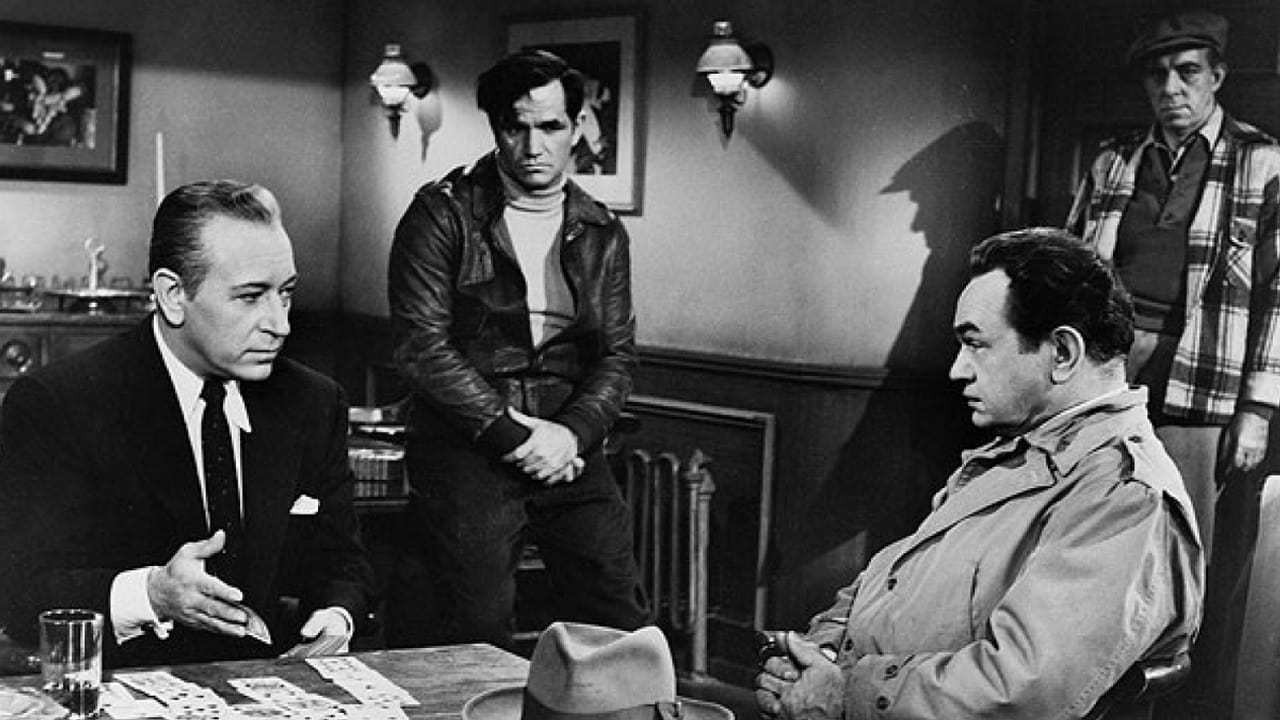
Bullet for Joey – scene
The Waterfront Rendezvous Shadow Falls on Water

The meeting at the docks is composed with a deliberate flatness that itself becomes expressive. Harry Neumann's camera holds at medium distance, refusing the glamour of tight close-ups, letting the figures occupy the lower half of the frame while cranes and moored hulls press in from above. Available darkness is supplemented by a single source lamp off-frame, enough to catch the angle of a jaw or the sheen of a wet surface without resolving faces into legibility. The composition refuses comfort.

The scene positions Victor as a man already enclosed before any physical trap is set. The architecture of the docks – vertical, industrial, indifferent – functions as an external diagram of his situation: a career criminal who has run out of geography. Neumann's reluctance to move the camera underlines the absence of exit, and what emerges is a portrait of a man for whom motion has always substituted for decision, finally forced to stand still.

Visual Language

The Cinematography

🎞️
Harry Neumann – Director of Photography

Harry Neumann, a cinematographer who spent much of his career in Poverty Row and independent production, brings to Bullet for Joey the economical precision that such conditions require. Working on a constrained budget for the Bischoff-Diamond Corporation, Neumann relies on hard-edged key lighting and compressed studio interiors to generate a sense of urban density without the expense of extensive location work. Shadow placement is functional rather than expressive – threats arrive from the periphery of the frame, and authority figures are lit with a flatness that strips them of heroic dimension, a choice that quietly equalizes the detective and the criminal. The Montreal exteriors that do appear are integrated sparingly, used primarily to establish geography rather than atmosphere. Neumann favors mid-range lenses that keep figures locked in their surroundings, denying them the isolation that tighter focal lengths might confer. The visual language ultimately serves the film's central moral logic: in a world of competing allegiances and ideological pressures, no one stands in clean light.

In the Catalogue

Themes & Motifs

Availability

Where to Watch

Also in the Directory

See Also