Texas, the early 1930s. Bonnie Parker, bored with small-town poverty and the blunt horizons of a waitress's life, falls in with Guy Darrow, a small-time criminal whose ambitions exceed his judgment. When Guy is sent to prison, Bonnie does not wait. She gravitates instead toward his brother Chuck and, eventually, toward the more ruthless Duke Jefferson, a man who understands that violence is a kind of currency. The gang begins robbing banks across the Southwest, and Bonnie – calculating, clear-eyed, and increasingly indifferent to consequence – assumes a role that is less accomplice than architect.
As the body count rises and law enforcement tightens its net, the alliances inside the gang begin to fracture. Guy, released from prison, re-enters Bonnie's orbit and finds that the woman he knew has been replaced by someone colder and more purposeful. The tension between Guy's residual decency and Duke's operational brutality forces Bonnie into a position she has been preparing for without admitting it: a choice between the man who once represented escape and the man who represents what escape actually costs. Paul Baxter and the other peripheral members of the outfit become liabilities as the gang's geography shrinks and lawman Tom Steel closes the distance.
William Witney's film belongs to the cycle of late-1950s crime pictures that treat the Depression-era outlaw not as a folk hero but as a symptom of institutional failure and individual corrosion. Shot with the economy of a B-picture but directed with more compositional care than the budget invites, it positions Dorothy Provine's Bonnie as a figure of desire and dread simultaneously – a woman whose criminality is not softened by romance and whose fate the film treats as arithmetic rather than tragedy.
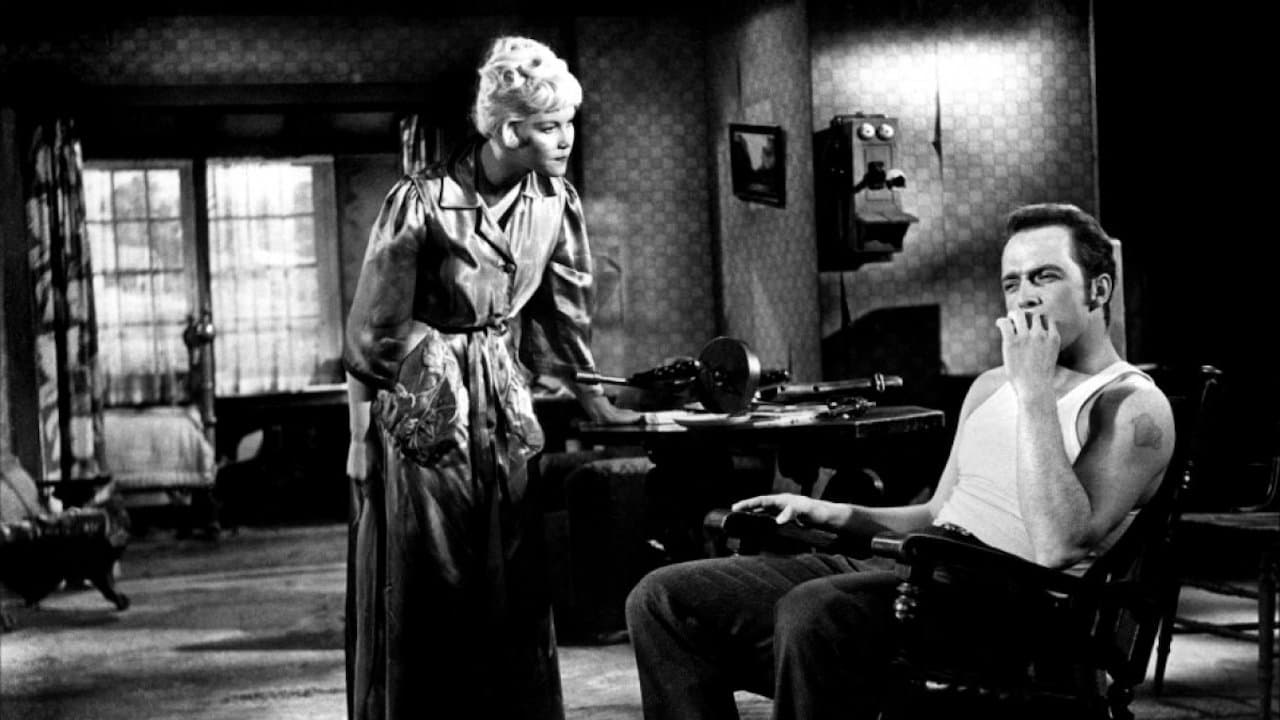
The Bonnie Parker Story arrives three years before the French New Wave would glamorize the outlaw couple and nine years before Arthur Penn's Bonnie and Clyde would mythologize the same source material into counterculture allegory. Witney's version, working within the constraints of Albany Productions and a seventy-nine minute runtime, makes no such claims. What it offers instead is something more uncomfortable: a portrait of a woman whose agency is neither romanticized nor pathologized but rendered as a fact of her environment. Dorothy Provine carries the film with a performance that refuses sentimentality without tipping into caricature. The script gives Bonnie operational intelligence and a capacity for detachment that the era's crime pictures rarely extended to female characters outside the femme fatale template. Witney, a director with long roots in serials and Westerns, brings a kinetic confidence to the action sequences while keeping the interior scenes observationally flat in a way that serves the material. The film is not without its B-picture roughness, but as a document of how Hollywood processed female criminality in the late Eisenhower years, it is more revealing than its reputation suggests.
– Classic Noir
Witney and cinematographer Jack A. Marta hold the camera at dashboard level, angled back toward Provine in the rear seat. The frame is tight – shoulders, jaw, eyes – and the light comes from the side, slicing her face into two distinct zones: one illuminated, one in shadow. The road unreels in the background through the rear window, flat and empty, the landscape offering no cover and no exit. Marta does not move the camera. The stillness of the shot against the motion implied by the moving vehicle produces a formal tension that the script never explicitly names.
The scene functions as a compression of the film's central argument. Bonnie is neither fleeing nor pursuing in this moment; she is simply present, watching, with an expression that has evacuated itself of surprise. The road behind her is the road she has already traveled, and the film uses the geography of the shot to suggest that for this particular woman, in this particular life, forward and backward have become indistinguishable. It is the closest Witney comes to a thesis statement, and he delivers it without dialogue.
Jack A. Marta shoots The Bonnie Parker Story with the disciplined pragmatism of a cinematographer who has spent years in the Republic Pictures system, where light was a problem to be solved before noon and interiors were built to be lit fast. Working in black and white on what were clearly limited locations, Marta favors hard side-lighting that carves faces into planes of contrast rather than modeling them with subtlety. The effect suits a film about people who have simplified themselves down to appetite and reflex. Exterior sequences on roads and in fields use available geography to create a sense of flatness – not aesthetic flatness, but the flatness of a world without depth to retreat into. Studio interiors are lit with sources that feel motivated but are placed with enough severity to keep the moral atmosphere legible. Shadow here is not decorative; it marks the spaces where decision has already been made and consequence is simply pending. Marta's lens choices tend toward the moderate wide end, keeping figures in relation to their environments rather than isolating them, which reinforces the film's insistence that Bonnie Parker is a product of specific conditions rather than an aberration.
Tubi has carried this title in a serviceable public-domain print; confirm availability before viewing as catalog rotation applies.
Archive.orgFreeArchive.org hosts a digitized print in the public domain, making it the most reliably permanent free option for this title.
Amazon Prime VideoSubscriptionAvailability varies by region and catalog cycle; check current listings as it has appeared here periodically on third-party add-on channels.