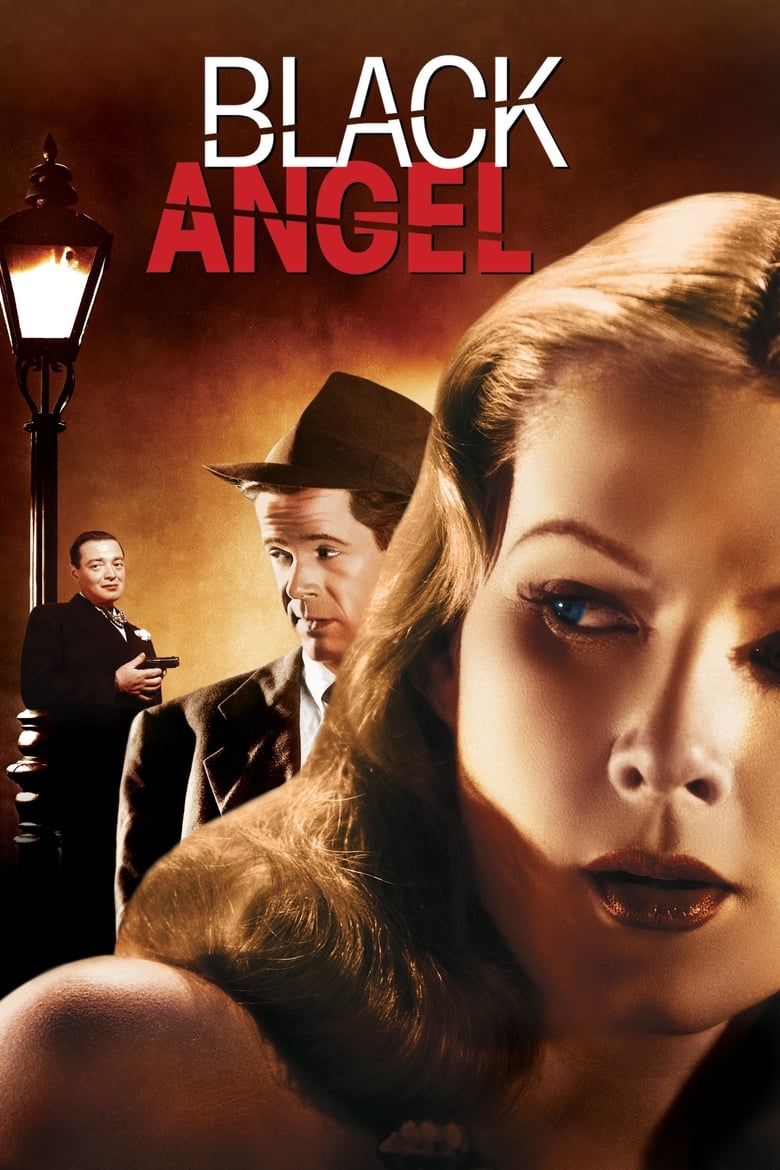
When nightclub singer Mavis Marlowe is found strangled in her Los Angeles apartment, her estranged husband Kirk Bennett is convicted of the murder and sentenced to death. His wife Catherine refuses to accept the verdict and sets out to find the real killer before the execution date. Her investigation leads her to Martin Blair, a composer and former lover of Mavis who was drunk on the night of the murder and remembers nothing – a man who is either an invaluable witness or the guilty party she is looking for.
Catherine and Martin form an uneasy alliance, taking work together at the club owned by the sinister Marko, a man with his own connection to the dead woman. As they grow closer, their partnership becomes complicated by genuine feeling on Martin's part and by the mounting evidence that points in directions neither of them wishes to follow. Captain Flood, a dogged police detective, watches from a distance, unconvinced that the right man is waiting in a cell.
Black Angel belongs to that strand of postwar noir built around guilt that cannot be located with certainty – stories in which the investigation is also a form of self-examination. The film uses the nightclub setting and the recovering alcoholic's unreliable memory to keep the moral ground unstable, making the search for truth a process that implicates the searcher. It is a modest picture in scale but not in its understanding of what the genre can do with an ordinary conscience under pressure.
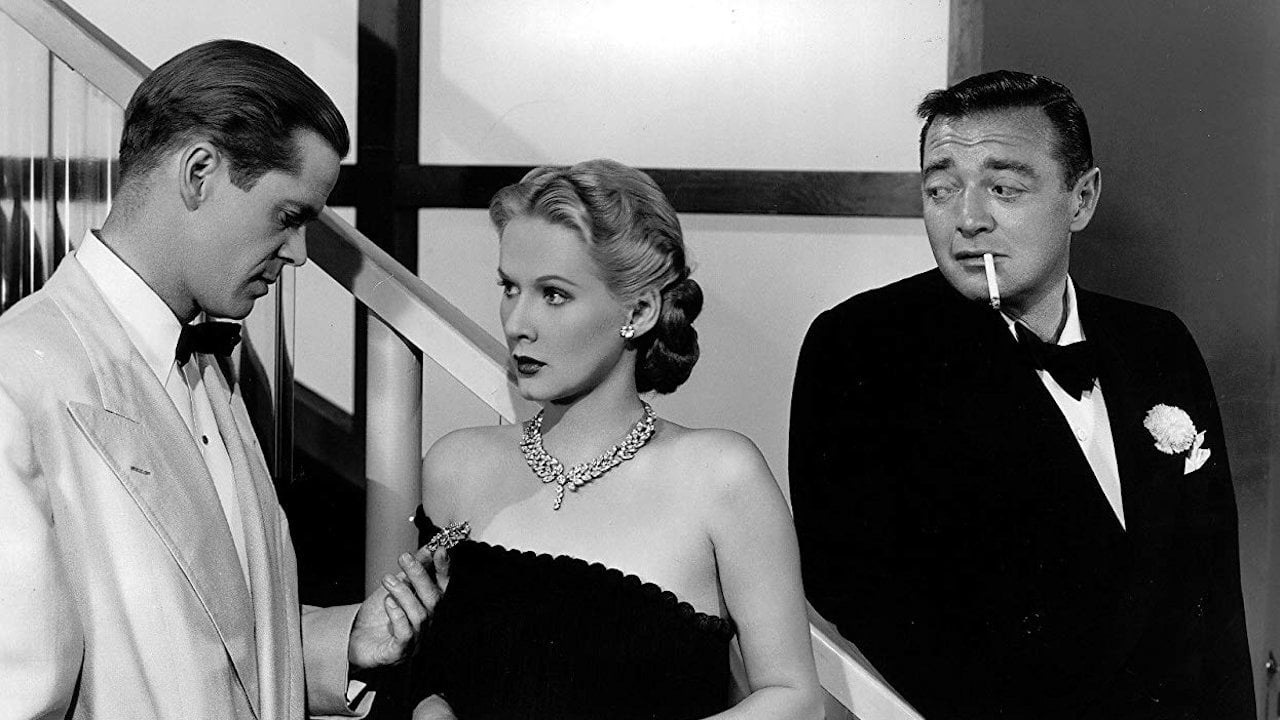
Black Angel is a film that earns attention less through visual extravagance than through the structural integrity of its central conceit. Roy William Neill, a director whose work tends to be undervalued because it rarely exceeds its genre, handles the material with a restraint that serves it well. Dan Duryea, who built his reputation playing snake-eyed villains, is cast here against type as a man genuinely uncertain of his own guilt – and the casting is not merely a stunt. Duryea locates something credible in Blair's self-disgust, making the character's amnesia feel like a moral condition rather than a plot mechanism. Peter Lorre's Marko is deployed with similar economy: menacing without theatrics, a presence that contaminates every scene he enters. The film reflects postwar Hollywood's growing interest in psychological instability as a subject rather than a backdrop, anticipating the more celebrated amnesia noirs that followed. It does not reach the formal ambition of its nearest contemporaries, but within its 81 minutes it makes its argument cleanly and without waste.
– Classic Noir
Martin sits at the club piano, the frame holding him in a pool of warm, directed light that separates him from the surrounding darkness of the room. The camera stays close, cutting between his hands on the keys and Catherine at a nearby table, her face positioned in softer, more diffuse illumination. The composition keeps the two characters in the same moral register while the physical distance between them remains visible – the piano functions both as barrier and as the medium through which Blair reveals what he cannot say directly.
The scene crystallises the film's central problem: Blair's gift is also his alibi and his accusation. The music he plays is the same music that was heard on the night of Mavis's death, and in performing it he simultaneously reconstructs the past and deepens his own uncertainty about it. Catherine's expression in these shots is not readable as trust or suspicion but as something between the two – the face of a woman who understands that she is depending on a man who cannot fully account for himself.
Paul Ivano's cinematography for Black Angel operates within the established Universal noir house style but applies it with particular attention to the moral architecture of individual scenes. Working largely on studio-constructed sets, Ivano uses relatively tight lens choices to keep the frame compressed, denying characters the visual freedom that might suggest escape or innocence. The nightclub interiors are lit from above and at steep angles, producing shadows that fall directly onto faces rather than into background space – a choice that places guilt on the surface of the image rather than in the atmosphere behind it. The scenes involving Marko make consistent use of low-key lighting with minimal fill, so that Lorre's face becomes partly illegible, withholding information that the narrative also withholds. Where Catherine and Martin share the frame, Ivano allows slightly more ambient light, not as warmth exactly but as the visual equivalent of provisional trust – illumination that could be withdrawn. The cinematography does not call attention to itself, which is its primary virtue.
Tubi has carried Black Angel as part of its classic Universal library; verify availability in your region before viewing.
Archive.orgFreeA public domain print is available via the Internet Archive, though transfer quality varies and should be treated as a fallback option.
Amazon Prime VideoRentalA rental copy is typically available through Amazon and generally offers the most consistent picture quality among easily accessible options.