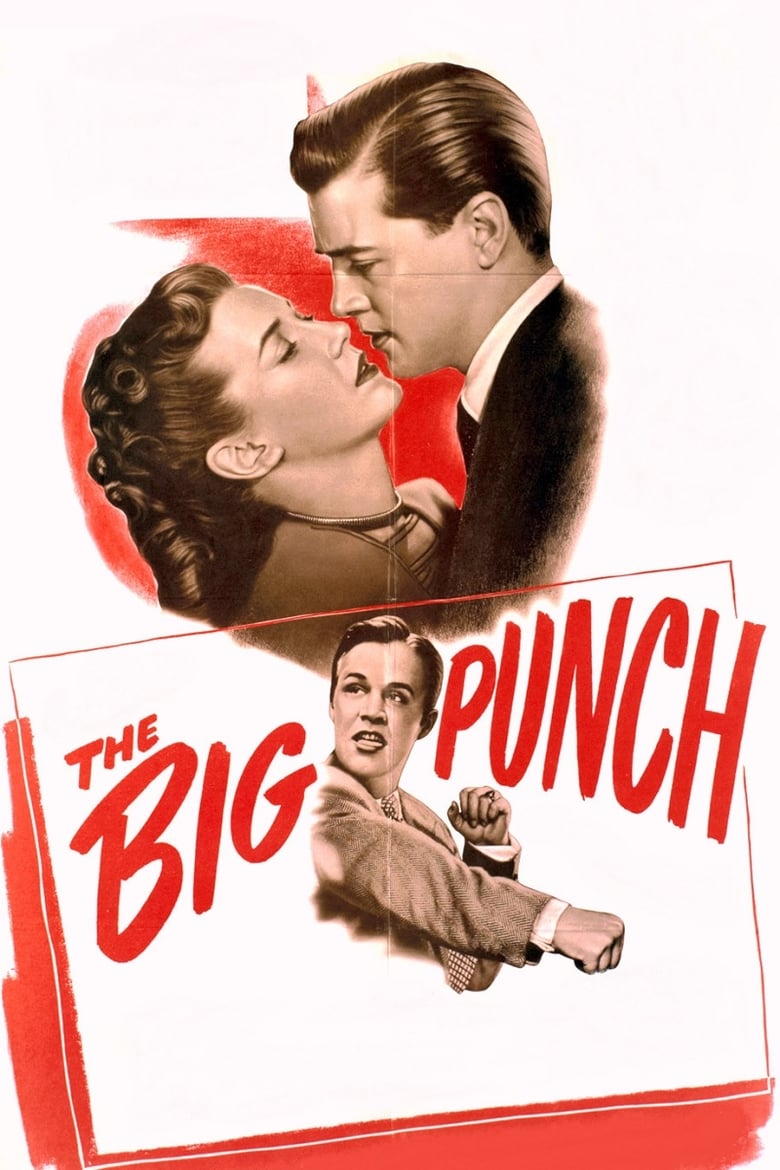
Chris Thorgenson, a promising heavyweight, takes the fall for a killing he did not commit and serves his time without betraying the man responsible. When he is released, he returns to a world that has moved on without him – his career diminished, his reputation tarnished, and the criminal network that used him still operating at full strength under the control of Con Festig, a syndicate enforcer with no intention of letting loose ends remain loose.
Johnny Grant, a former associate whose loyalties are genuinely uncertain, occupies the contested space between Chris's desire for a clean life and Festig's demands for continued compliance. Karen Long and Midge Parker pull the two men in opposing directions, their attachments shaped less by sentiment than by survival. As Festig tightens his grip, the question ceases to be whether Chris can reclaim his career and becomes whether he can reclaim anything at all.
Big Punch belongs to that strand of postwar noir in which the boxing world functions as a compressed image of a corrupt society – the ring a controlled space where violence is licensed, and the streets around it where violence is simply practiced. The film is less interested in redemption than in the cost of delayed resistance, and it places its protagonist in a situation where doing the right thing, finally and late, may settle accounts but cannot undo what the years inside have taken.
Big Punch occupies the lower tier of Warner Bros.' postwar crime output, yet it earns its place in the genre record with some precision. Sherry Shourds, working with limited resources and a cast whose marquee value was already declining by 1948, constructs a film that understands the boxing noir formula without merely recycling it. Wayne Morris brings a worn physicality to Chris Thorgenson that serves the material well – this is not a hero who inspires confidence, and that uncertainty is the film's most honest quality. Gordon MacRae, between musical assignments at the studio, is credible as a man whose charm conceals a fundamental unreliability. What the film captures with some accuracy is the postwar sense that the institutions meant to rehabilitate men – the justice system, the athletic world, the social contract itself – are quietly managed by the same interests that put those men away in the first place. The film does not press this argument hard, but it does not abandon it either.
– Classic Noir
Carl E. Guthrie frames the sequence with the ring ropes dividing the foreground into geometric diagonals, the overhead lamp casting a tight cone of white light that stops well short of the walls. Chris trains alone, and Guthrie keeps the camera low, shooting upward so that the fighter's shadow moves across the water-stained ceiling in a distorted, elongated form that bears no useful relationship to the man throwing the punches below it.
The scene argues, without dialogue, that Chris's effort and his actual situation have come apart. He is preparing for a fight whose terms he does not control, rehearsing a form of agency that the film has already shown to be conditional. The shadow on the ceiling is not his future; it is the shape that Festig's organization casts over everything he does, enlarged and inescapable.
Carl E. Guthrie, a Warner Bros. contract cinematographer whose work across the studio's crime and melodrama output is consistently undervalued, brings a functional discipline to Big Punch that suits the film's stripped-down structure. His lighting avoids the baroque shadow architecture of the genre's more celebrated entries in favor of something harder and more institutional – single-source setups that flatten faces and leave backgrounds underlit without theatrical emphasis. The gymnasium sequences use available-style overhead illumination that locates the film in working spaces rather than expressionist abstractions. In the exterior scenes, Guthrie keeps the depth of field tight, compressing the city behind his characters so that the environment offers no exit. The effect is less atmosphere than pressure – a visual language that does not aestheticize the protagonist's situation but simply refuses to give him room. It is cinematography in service of moral argument rather than mood.
Tubi has carried a number of Warner Bros. B-crime titles from this period and is the most likely free streaming source for this film, though availability should be verified.
Archive.orgFreeIf the film has entered the public domain or been made available through institutional deposit, Archive.org offers the most stable no-cost access without regional restrictions.
TCMSubscriptionTCM periodically programs Warner Bros. boxing and crime noirs in thematic blocks and remains the best venue for a broadcast-quality presentation with contextual notes.