Kathy Lawrence, a resourceful newspaper reporter, is convinced that a corrupt judge named Finlay Drake has gone into hiding inside a secluded private sanitarium to avoid prosecution. Unable to gain access through legitimate means, she recruits Ross Stewart, a down-on-his-luck private investigator, and arranges for him to have himself committed as a patient. Once inside, Ross must maintain his cover among genuinely disturbed men while searching the institution for evidence of Drake's presence.
The sanitarium proves to be something far more sinister than a convenient hiding place. Dr. Clifford Porter runs the facility with a cold authority that discourages questions, and the staff enforces order through intimidation and worse. Among the patients, Ross encounters Larson, a dangerous man who senses that the new arrival is not what he claims, and a former associate named Fred Hopps whose deteriorating mental state may be the result of deliberate manipulation. Kathy, working from outside, grows increasingly uncertain whether Ross can hold his cover long enough to survive.
Behind Locked Doors belongs to that compact strand of late-1940s noir that locates its dread not in urban streets but in institutional spaces where authority has curdled into something predatory. The sanitarium setting allows the film to interrogate questions of sanity and performance, of who gets to define reason and who gets locked away for threatening the powerful. At sixty-two minutes, it moves without waste, its modest budget channeled into atmosphere rather than spectacle.
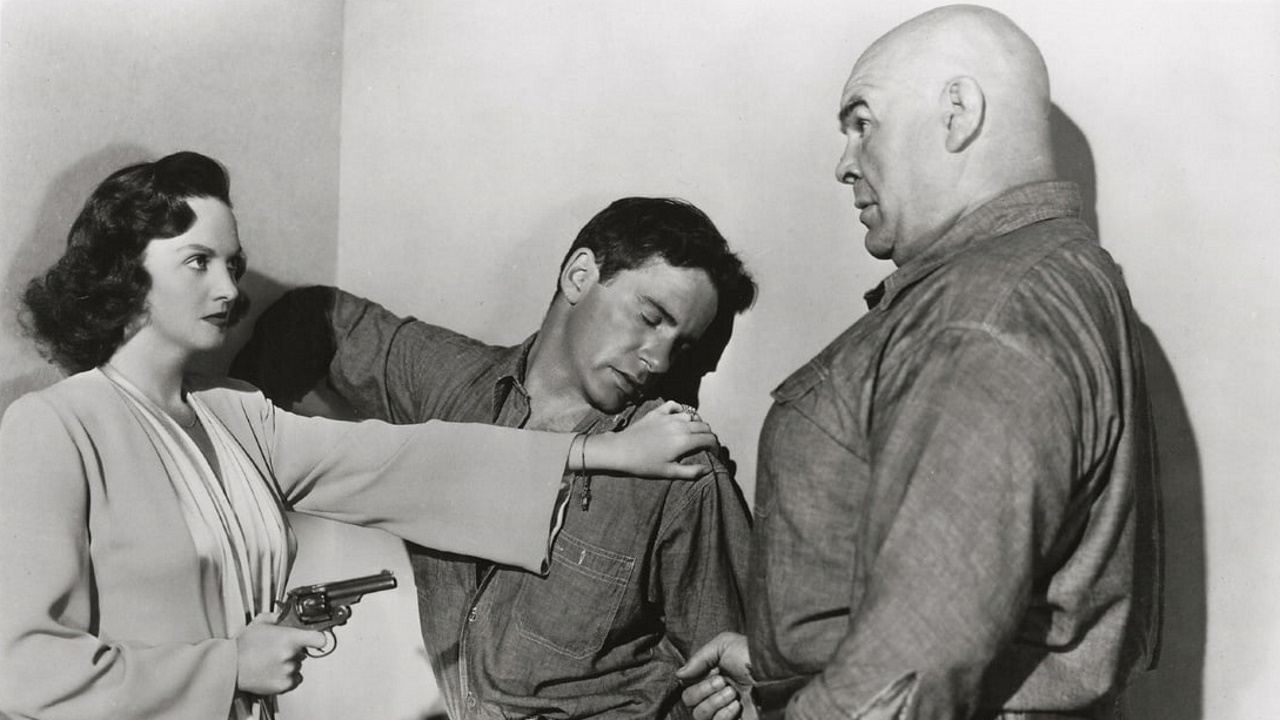
Behind Locked Doors is a minor but coherent entry in the postwar cycle of institutional noir, films that found corruption not in shadowy alleys but behind the legitimate facades of hospitals, courts, and asylums. Budd Boetticher, still two years away from the crime pictures that would sharpen his reputation, directs with functional economy rather than distinction, but he understands the claustrophobic logic the material requires. Richard Carlson brings a credible everyman quality to Ross Stewart: he is not a hard man, which makes his predicament more genuinely uncomfortable than that of most noir protagonists. The film's most durable insight is structural rather than thematic – by placing its investigator inside the institution as a patient rather than an outsider looking in, it collapses the distance between the sane and the dangerous, between the observer and the observed. Aro Productions was working at the low end of independent budgets, and that constraint is legible on screen, but it also produces an accidental tightness that larger productions often lack.
– Classic Noir
The camera moves through the ward after lights-out with a stillness that feels less like calm than suspension. Guy Roe keeps the frame low and close, the ceiling pressing down into the composition. Light enters in narrow bands through the barred window grilles, laying parallel shadows across the floor and across the faces of sleeping men, the geometry of confinement made literal. Ross lies awake at the edge of frame, his face half-consumed by shadow, his eyes the only element in the shot that registers movement.
The scene does not advance the plot in any conventional sense, but it performs the film's central argument: that the line between the man faking madness and the men around him who are not faking is thinner than his confidence in himself. The institutional dark is the same dark for everyone. What the moment reveals about Ross is that he is beginning to feel this, and what it reveals about the film is that Boetticher and his collaborators understand the difference between a premise and a predicament.
Guy Roe, a journeyman cinematographer who worked consistently across B-pictures of the period, brings a disciplined low-key approach to Behind Locked Doors that serves the material without calling attention to itself. Working within the confinement of studio-built interiors meant to suggest institutional architecture, Roe favors tight focal lengths that compress the space, making corridors feel shorter and rooms feel smaller than their actual dimensions. His lighting setups rely on hard sources placed at low angles, producing shadows that behave like architecture, subdividing the frame into zones of visibility and concealment. The barred window motif recurs with enough consistency to function as visual grammar rather than decoration, each iteration reinforcing the film's argument that surveillance and confinement are conditions the powerful impose on others to maintain their own freedom. The camera rarely moves when it could hold, and when it does move, the movement is horizontal and deliberate – tracking along walls rather than ascending, keeping the weight of the ceiling in frame.
As a public domain title, Behind Locked Doors is available here in multiple transfers; quality varies, but the best uploads offer a watchable full-frame print.
TubiFreeTubi has carried public domain noir titles from this era with some regularity, though availability should be confirmed at time of viewing.
Amazon Prime VideoFreeAvailable periodically through Prime's rotating catalog of public domain titles; check current availability before searching.