Films People Pull a Fast One Night Beat Reading Room On TV Shop
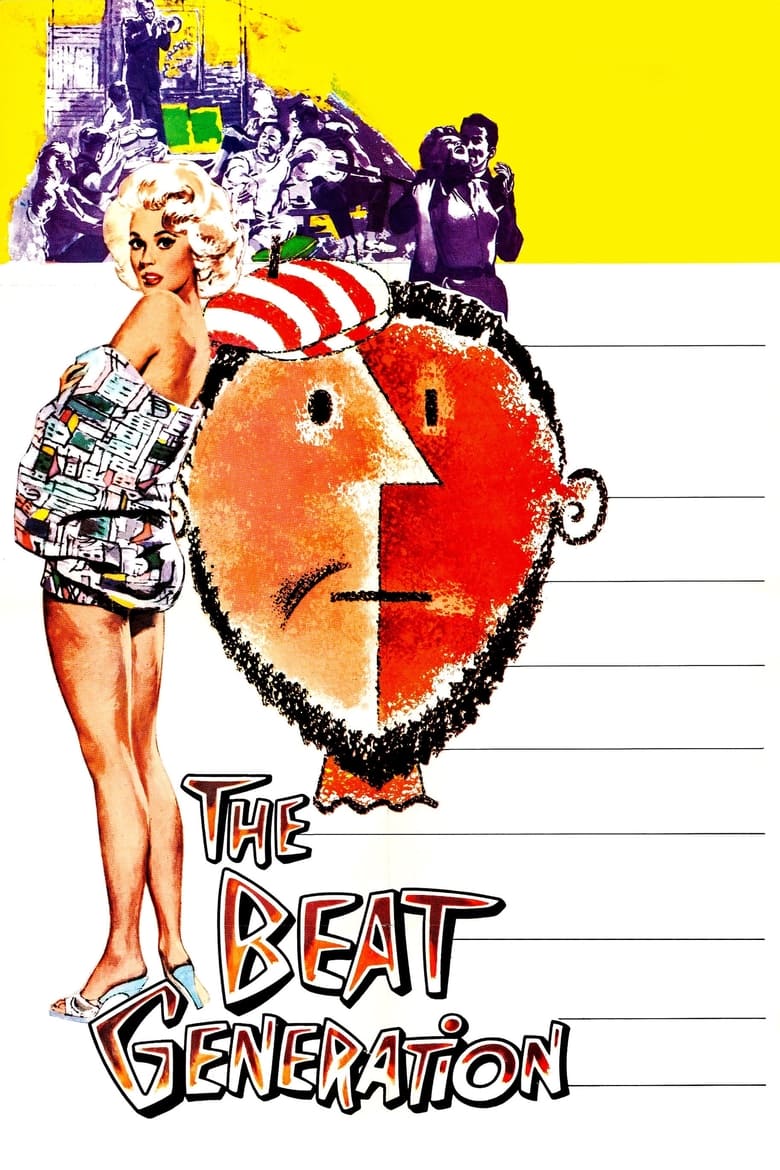
Beat Generation 1959
1959 Albert Zugsmith Productions
★★★☆☆ Notable
Film Noir · 95 minutes · Black & White

Beat Generation

Directed by Charles F. Haas
Year 1959
Runtime 95 min
Studio Albert Zugsmith Productions
TMDB 5.2 / 10
"A city's predator moves freely among those too frightened, or too modern, to name him."

Los Angeles detective Dave Culloran is hunting a serial rapist who has adopted the social camouflage of the Beat Generation subculture – coffeehouses, jazz clubs, and the studied indifference of the city's bohemian fringe. When the attacker strikes close to home and Culloran's own wife Francee becomes a victim, the case ceases to be professional. Culloran is a blunt instrument of the law, methodical and worn at the edges, working a city that has learned to aestheticize its own moral looseness.

The investigation pulls Culloran into the orbit of Stanley Belmont, a smooth, predatory figure who wears the Beat milieu like a disguise, and of Georgia Altera, whose position between the detective world and the subculture complicates every assumption Culloran carries. The damage done to Francee reshapes the marriage from the inside, forcing a reckoning that the procedural plot keeps deferring. Allegiances in the precinct and on the street alike prove unreliable, and the film uses the jazz-club atmosphere – Louis Armstrong appearing as himself – to underscore how performance and concealment have become indistinguishable.

Beat Generation sits at the intersection of the police procedural and the social-problem picture, pressing the noir framework into service as a critique of a cultural moment. Its central argument is that any subculture built on the rejection of conformity is equally available to the genuinely aberrant, a proposition the film pursues with more seriousness than its exploitation trappings initially suggest.

Classic Noir

Beat Generation arrives in 1959 as producer Albert Zugsmith's attempt to colonize two headlines at once – the moral panic surrounding Beat culture and the persistent public appetite for the rapist-as-monster procedural – and the friction between those ambitions is precisely what gives the film its documentary edge. Charles F. Haas directs without flourish, which serves the material: the coffeehouses and jazz joints feel observed rather than constructed, and the film's refusal to sentimentalize either Culloran's marriage or the subculture it surveys keeps it from collapsing into simple condemnation. Ray Danton's Belmont is the film's most considered creation, a criminal who understands that nonconformity provides cover, and his presence articulates something the decade's sociological literature was still working out. Steve Cochran's weary authority anchors the procedural strand without heroizing it. The film cannot entirely escape its era's tendency to conflate deviance with danger, but it handles the assault on Francee with restraint unusual for the cycle, redirecting the violence inward toward the marriage rather than outward toward spectacle.

– Classic Noir
3 ★★★☆☆ Notable
Credits

The Crew

DirectorCharles F. Haas
ScreenplayRichard Matheson
CinematographyWalter Castle
MusicAlbert Glasser
EditingBen Lewis
ProducerAlbert Zugsmith
Performances

The Cast

Close Reading

The Signature Scene

Beat Generation – scene
The Coffeehouse Interrogation Light Through Cigarette Smoke

Walter Castle frames the scene in a low-ceilinged room where practical lamp sources barely penetrate the middle ground, leaving the far wall in a sustained darkness that the camera never fully resolves. Cochran and Danton are placed across a small table, the frame bisected by the vertical of a support column that keeps each man in his own half of the image. The camera holds in medium two-shot longer than comfort allows, resisting the cut that would release the tension, while smoke drifts through the single overhead source and softens whatever certainty either man brings to the conversation.

The composition argues what the screenplay only implies: that Culloran and Belmont occupy the same physical world by entirely different moral geometries, and that the law's tools – observation, confrontation, the held gaze – are insufficient against a man who has made himself at home in ambiguity. The column between them is not metaphor so much as structural fact, and the film is honest enough to let it stand without comment.

Visual Language

The Cinematography

🎞️
Walter Castle – Director of Photography

Walter Castle works Beat Generation in a register that resists the high-contrast expressionism of classic noir in favor of a flatter, more institutional gray scale that suits the film's procedural ambitions. Shooting largely on studio interiors dressed to approximate Los Angeles's late-1950s bohemian geography, Castle opts for diffused practical sources – neon signs, hanging bulbs, tabletop lamps – that spread light unevenly and leave significant portions of the frame in genuine shadow rather than decorative darkness. The effect is of a city whose illumination is always provisional. Lens choices favor moderate focal lengths that keep backgrounds legible, refusing the compressed depth that would aestheticize the environment; this is a film that wants its locations to feel inhabited rather than designed. The camera's relative stillness during confrontational scenes places the burden of unease on performance and negative space rather than movement, a discipline that pays particular dividends in the scenes involving Danton, where what is withheld from the frame matters as much as what Castle chooses to show.

In the Catalogue

Themes & Motifs

Availability

Where to Watch

Also in the Directory

See Also